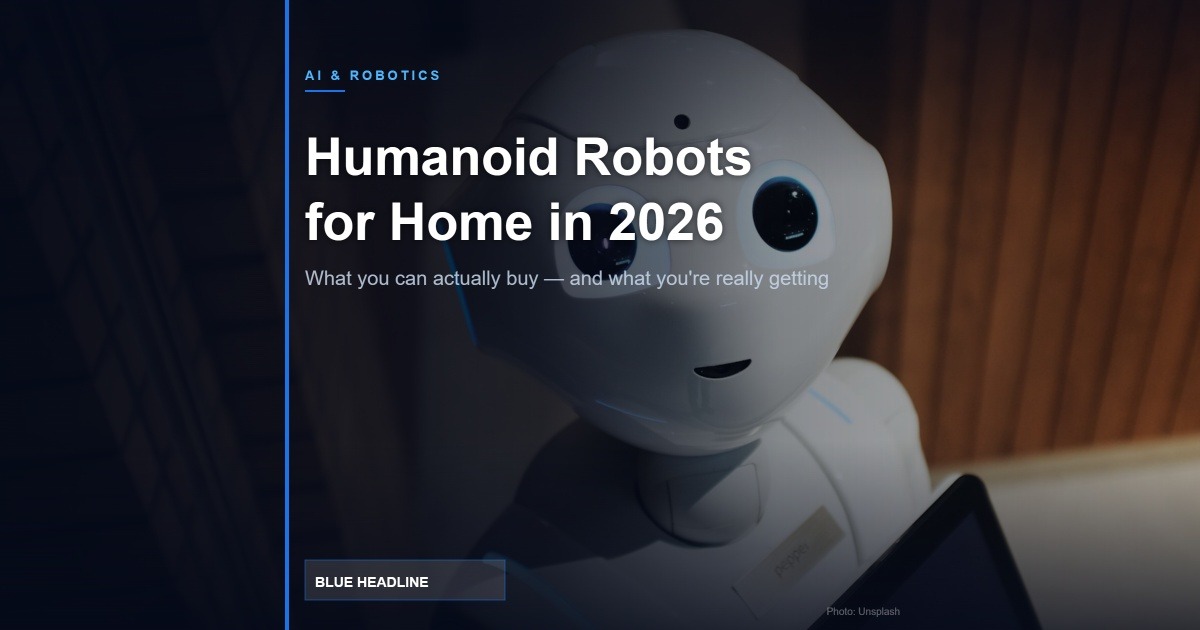
A humanoid robot that unloads your dishwasher, waters your plants, and folds your laundry sounds like pure science fiction. In 2026, you can actually order one online — for $20,000. The catch? It still needs a human to drive it.
For decades, the humanoid home robot has been tech’s most tantalizing broken promise. Every few years, a slick demo video goes viral, investors pour in billions, and the internet collectively loses its mind. Then nothing ships. In 2026, something genuinely different is happening: humanoid robots are actually arriving at front doors — and the reality is far more interesting, and far more complicated, than the headlines suggest.
Whether you’re a curious tech enthusiast, a potential early adopter, or just someone trying to figure out whether to believe the hype, here’s the most honest breakdown of what you can actually buy, what it actually does, and whether any of it is worth it.
“The 1X Neo is one of the first humanoid robots built for your home… For $20,000, you can actually own one. We tested it — and it got weird.”
— The Wall Street Journal, February 2026
Before we dive in, watch the WSJ’s real-world test — it tells you more than any spec sheet ever could:
The $20,000 Question: What Can You Actually Buy Right Now?
Let’s cut straight to it. As of early 2026, there are real humanoid robots you can purchase. Not “reserve a spot on a waitlist” — actually buy. Here are the main players targeting the consumer and prosumer market:
1. 1X NEO — $20,000 (or $499/month)
The NEO from Norwegian startup 1X Technologies is arguably the most talked-about home humanoid robot of 2026. At 5’6″ and designed specifically for household tasks, it’s the first robot built explicitly for life inside a normal home — not a warehouse or a lab.
What it can theoretically do: unload the dishwasher, water plants, carry groceries, tidy up. What it can actually do autonomously right now? Not much. In a live demonstration with a Wall Street Journal reporter, every single task NEO performed was controlled remotely by a human teleoperator — not AI. Loading a dishwasher took five minutes. Retrieving a water bottle from the fridge took over a minute. Folding one sweater: two minutes of painstaking manipulation.
The company says NEO operates at 60–70% autonomy at launch, with human assistance filling the gaps. And here’s the part buried in the fine print: those human “assistants” are real people at 1X who can see inside your home.
“Privacy concerns are real and legitimate. An incredibly sophisticated robot in your home will inevitably collect intimate data about your life.”
— University of New South Wales, 2026
Bottom line on NEO: A fascinating, genuinely impressive piece of engineering that is absolutely not ready to be your household helper. It’s an early-access research platform dressed up for consumers.
2. Unitree G1 — Starting at $13,500
Chinese robotics firm Unitree has made waves by releasing capable humanoid robots at prices that undercut Western competitors dramatically. The G1 starts at $13,500 for the basic version, though the research-ready EDU Standard jumps to $43,500 with full SDK access.
Standing 1.32 meters tall with up to 43 degrees of freedom, the G1 comes equipped with Intel RealSense depth cameras, LIVOX LiDAR, and AI-driven locomotion. About 5,000 units shipped in the first half of 2025, mostly to academic institutions, corporate R&D teams, and entertainment companies — including deployments at Stanford, MIT, and Amazon research labs.
For an average consumer? The G1 is a developer’s robot. You’ll need serious programming chops — custom C++ development — to make it do anything beyond its pre-programmed routines. You can actually find the Unitree G1 on Amazon, which says something about where the market is heading. But don’t let the familiar storefront fool you into thinking it’s a consumer product yet.
3. Unitree R1 — Starting at $4,900–$5,900
Named one of TIME’s Best Inventions of 2025, the R1 is the most affordable humanoid robot on the market today. At 25 kg and roughly 55 lbs, it’s compact and athletic. Battery life is around one hour — barely enough for a meaningful work session — and like the G1, it’s aimed squarely at developers and researchers rather than everyday households.
The $5,900 price tag sounds tempting. But unless you have a team of robotics engineers, this is more of a sophisticated hobby project than a household assistant.
The 1X NEO in Action: What the Marketing Doesn’t Show
What About Tesla Optimus and the Big Names?
Here’s where a lot of readers will have questions, because the big splashy names dominate the headlines. Let’s be direct:
Tesla Optimus: As of February 2026, there are no public sales, no pre-orders, and no confirmed shipping dates for consumers. Tesla is reportedly targeting a production line by late 2026, with public availability potentially in 2027. The demos have been impressive — but AI demos have a long history of overpromising. Three years of impressive demos and still no purchase button.
Amazon’s robots: Amazon has deployed over one million robots in its warehouses, coordinated by its DeepFleet AI system. These are industrial, purpose-built machines — not humanoids, not for home use, not for sale to you.
Figure, Agility Robotics, Boston Dynamics: All focused on industrial and commercial deployments — manufacturing floors, logistics centers, last-mile delivery. The neural network breakthroughs powering these systems are genuinely exciting, but the applications are B2B, not B2C.
Robot Price vs. Capability: Where Things Actually Stand
| Robot | Price | Target User | Autonomy Level | Battery |
|---|---|---|---|---|
| 1X NEO | $20,000 / $499mo | Early adopters, home | 60–70% (teleoperated) | 4 hours |
| Unitree G1 | $13,500–$43,500 | Researchers, devs | Programmable | 2 hours |
| Unitree R1 | $4,900–$5,900 | Developers, hobbyists | Programmable | 1 hour |
| Tesla Optimus | Not for sale yet | TBD (2027?) | Unknown | Unknown |
| Boston Dynamics Atlas | ~$150,000+ | Industrial / R&D | High (specific tasks) | ~1 hour |
The Privacy Problem Nobody Is Talking About Enough
When you buy a humanoid robot for your home in 2026, you’re not just getting a machine. You’re inviting a camera, a microphone, a set of sensors — and in many cases, remote human operators — into the most private space in your life.
The 1X NEO explicitly requires human teleoperators who can see inside your home to handle tasks the AI can’t manage. The company collects that data to train future AI systems. This connects directly to a broader trend we’ve been tracking: AI agents are increasingly making decisions you can’t explain or control.
In 2026, privacy frameworks for home robots barely exist. Regulation is years behind the technology. If you’re considering an early purchase, read the privacy policy. Then read it again.
This isn’t hypothetical — it’s the same dynamic we’re seeing across all AI systems. As data security becomes increasingly central to AI deployment, home robots represent one of the most intimate new frontiers for potential exposure.
Hype vs. Reality: The Honest Scorecard
| What the Marketing Says | What’s Actually True in 2026 |
|---|---|
| “Fully autonomous home assistant” | Mostly teleoperated; 60–70% autonomy at best |
| “Does your chores for you” | Can do some tasks, slowly and imperfectly, with supervision |
| “Affordable at $5,900” | Affordable hardware; useless without serious engineering expertise |
| “Learns and improves over time” | True — but your data helps train the robot for everyone |
| “The future is here” | The very early future is here. The useful future is still arriving. |
So Who Should Actually Buy One Right Now?
Here’s the honest answer: very few people.
The profile of the ideal 2026 humanoid robot buyer looks something like this: you’re a robotics researcher, a developer, a tech company running R&D experiments, or a genuinely passionate early adopter with $15,000–$20,000 to spend on what is essentially a sophisticated, expensive, ongoing project rather than a finished product.
If you’re a regular household looking for help around the house, the math doesn’t work yet. A $20,000 investment in a robot that requires human supervision, has a 2–4 hour battery life, and can’t fold your laundry without a teleoperator in the loop is not a practical household solution. A cleaner, a dishwasher, and a Roomba still beat it on ROI.
That said — the trajectory is genuinely exciting. The Unitree R1 at $5,900 would have cost $500,000 five years ago. This connects to the same exponential trend we see in AI more broadly: AI capabilities are improving faster than most people expect. The Moore’s Law equivalent in humanoid robotics is real, and it’s accelerating.
What to Watch in the Next 12–18 Months
If you’re not buying now but want to track this space, here are the milestones that will actually matter:
- Tesla Optimus public pre-orders — If and when this opens, it will legitimize the category in a way nothing else has.
- 1X NEO autonomy updates — Watch for the moment NEO can complete a task without a human in the loop.
- Price points dropping below $3,000 — That’s likely the threshold where mass consumer adoption becomes realistic.
- Regulatory frameworks — The first country to establish clear privacy and safety rules for home robots will shape the entire industry. Wired’s robotics coverage and IEEE Robotics are the best places to track this.
- Battery breakthroughs — 8+ hour continuous operation is the minimum bar for a genuinely useful home robot. We’re not there yet. This is closely tied to the broader energy and sustainability tech revolution.
The Bottom Line
Humanoid robots for the home are no longer science fiction — they’re science in progress. You can buy one today. It will be fascinating, frustrating, genuinely impressive in moments, and deeply limited in others. It will cost you more than a used car and require more patience than a new operating system.
The robots are real. The promise is real. The gap between the two is also very real — and in 2026, that gap is still measured in years, not months.
“Useful and widely accepted home androids may still be 20 years away.”
— International Federation of Robotics, 2026 Global Report
The robot revolution is happening. It’s just doing it slowly, methodically, and with a two-hour battery life.
Found this breakdown useful? Share it with someone who’s been falling for the hype. And if you want to stay ahead of what’s actually happening in AI and robotics — without the spin — check out more of our AI & Robotics coverage here.
Would you buy a humanoid robot for your home in 2026? Drop your thoughts in the comments below.
Whether you’re researching robotics or just browsing, your privacy matters. NordVPN is our top-rated VPN for 2026 — fast, reliable, and easy to set up on any device.
Comments
No comments yet. What did you think?