Robotics still has an annoying habit of relearning the same lesson for every new machine.
Train a strong control system on one robot, swap the hardware, and suddenly the “intelligence” looks a lot less general. That frustration sits underneath a new arXiv paper on hardware-agnostic quadrupedal world models.
The authors are tackling a problem the industry badly wants solved: how to build robot brains that transfer across bodies instead of starting over every time the limb lengths, actuator dynamics, or mass distribution change.
If world models stay locked to one embodiment, robotics scales like bespoke consulting. If they start to generalize across morphology, robotics begins to look more like a reusable software platform.
This story fits naturally beside our broader coverage of physical AI, why real-world constraints break demo magic, and how robotics only gets economically interesting when learning stacks become more reusable across machines.
Table of Contents
Why World Models Keep Breaking When the Body Changes
The paper names the problem directly. Current world models are often hardware-locked specialists.
“A model trained on a Boston Dynamics Spot robot fails catastrophically on a Unitree Go1 due to the mismatch in kinematic and dynamic properties, as the model overfits to specific embodiment constraints rather than capturing the universal locomotion dynamics.”
Source: arXiv abstract for 2604.08780
That is the real bottleneck. A small change in actuator behavior, limb length, or mass distribution can force teams to retrain from scratch.
For a field that likes to talk about general robot intelligence, that is a very narrow kind of generalization.
This is also why reusable learning infrastructure matters so much more than flashy robot videos. Without portability, every new body becomes a new tax.
What Morphology Conditioning Actually Changes
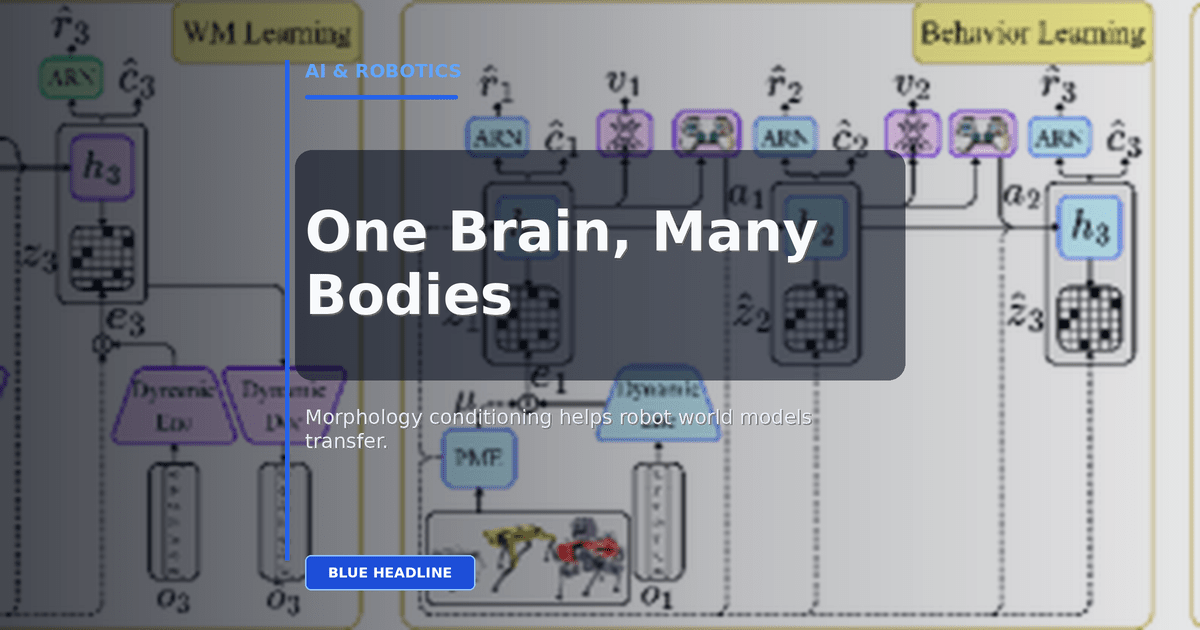
The authors introduce a Quadrupedal World Model, or QWM, that explicitly conditions its generative dynamics on the robot’s engineering specifications.
That is the crucial design choice. Instead of asking the model to infer body properties from motion history alone, the system feeds morphology in directly.
| Approach | What the model has to do | Main risk |
|---|---|---|
| Implicit system identification | Guess the robot’s body from observed motion | Adaptation lag and weaker zero-shot behavior |
| Morphology conditioning | Use explicit engineering specs as inputs | Still bounded to a family, but faster and cleaner transfer |
The paper combines a physical morphology encoder with a reward normalizer so the model can separate environmental dynamics from robot shape.
The goal is not a universal physics engine. It is a world model that can generalize across a family of related quadruped bodies.
“We introduce, for the first time, a world model that enables zero-shot generalization to new morphologies for locomotion.”
Source: arXiv abstract for 2604.08780
Why Explicit Specs Beat Guessing
A lot of machine-learning work loves hidden-state inference because it sounds elegant. In robotics, elegance can become lag, and lag can become unsafe behavior.
If the model has to watch motion for a while before it understands what kind of body it is controlling, you are already losing time and potentially making worse decisions. This paper’s push for explicit conditioning is more practical.
Tell the model what body it is controlling. Then let it reason from there.
That may sound obvious, but it reflects a bigger maturity shift. Robotics does not only need models that adapt. It needs models that adapt quickly enough to be useful and predictable in the real world.
Why This Matters for Robotics Economics
Portable intelligence is one of the few things that could genuinely change robotics economics.
If every new form factor requires a full retraining cycle, companies keep paying embodiment tax forever. But if a world model can interpolate across a quadrupedal family, teams can reuse more of the learning stack and move faster between platforms.
That does not only help labs. It helps product teams building real fleets, suppliers supporting multiple hardware lines, and integrators trying to avoid one locked hardware-software bundle per deployment.
This is where the paper connects back to our broader physical-AI theme. Reusable internal models are a much better sign of platform maturity than isolated hero demos.
What It Still Does Not Solve
The paper is refreshingly honest that QWM is not a universal physics engine. It operates as a distribution-bounded interpolator within the quadrupedal morphology family.
That caveat matters. This is not “train once, control every legged machine on Earth.” It is a serious step toward zero-shot transfer inside a bounded but meaningful family of bodies.
And honestly, that kind of narrowing is a strength. In robotics, honest scope is more valuable than fake generality.
A method that works well across a real family of related machines is already a meaningful advance.
Bottom Line
This quadrupedal world-model paper matters because it treats robot morphology as an input to reason over, not an obstacle to rediscover from scratch every time.
That is a subtle shift, but an important one. It points toward robot intelligence that can travel more easily across hardware families, which is exactly what the industry needs if it wants to scale faster than its retraining bills.
My bottom line: one robot brain, many bodies is still more ambition than reality. But morphology-conditioned world models make that ambition look less like a slogan and more like a serious engineering direction.
Primary sources and references: arXiv abstract and HTML paper.
Comments
No comments yet. What did you think?