About 1 in 3 American adults takes a multivitamin. Many hope it’s cheap insurance against heart disease, cancer or ageing.
So do multivitamins work? For most healthy adults, the honest answer is: not much, at least for the things people hope for.
There is one interesting exception, and a few people who really do need extra nutrients.
- For healthy adults, multivitamins don’t seem to prevent heart disease or early death.
- They may cut cancer risk a little, but the effect is small and the evidence has gaps.
- Some single supplements, like beta-carotene, can cause harm.
Do multivitamins work?
For preventing serious disease in healthy adults, mostly no.
In 2022, the US Preventive Services Task Force reviewed every major trial. This is the independent panel that advises American doctors on prevention.
It said the evidence was too weak to recommend multivitamins for preventing heart disease or cancer. It recommended against beta-carotene and vitamin E for that purpose.
A huge 2024 study then followed 390,124 adults for up to 27 years. Daily multivitamin users didn’t live longer.
That doesn’t mean vitamins don’t matter; your body needs them. It means that, if you already eat reasonably well, extra pills add little.
What the research shows
The big review: 84 studies
The Task Force’s evidence review pooled 84 studies with 739,803 people. It looked at healthy adults with no known deficiency.
| Supplement | What the review found |
|---|---|
| Multivitamins | About 7% fewer cancers, no clear effect on heart disease or death |
| Vitamin D | No effect on death, heart disease or cancer |
| Vitamin E | No effect on death, heart disease or cancer |
| Beta-carotene | 20% more lung cancer and 10% more heart deaths, in people at high risk of lung cancer |
The multivitamin cancer result came from 4 trials with 48,859 people. In real terms, that meant 0.2 to 1.2 fewer cancers per 100 people in the larger trials.
The review also said the multivitamin evidence had “important limitations”, so the cancer result is far from settled.
Single vitamins did no better
Many people skip the multivitamin and take one popular vitamin instead. The review tested those too.
Vitamin D is the big one. Across 27 trials with 117,082 people, it made no difference to the risk of death.
It also made no difference to cancer, in 19 trials with 86,899 people. That doesn’t cover bones or people who are truly low, only prevention in healthy adults.
Vitamin E fared the same. In 9 trials with 107,772 people, it didn’t change the risk of death.
For other single supplements, the review called the evidence for benefit “equivocal, minimal, or absent”.
The longest trial: 14,641 male doctors
The best single trial is the Physicians’ Health Study II. It gave 14,641 US male doctors aged 50 or older a daily multivitamin or a dummy pill.
They were followed for about 11 years. Neither the doctors nor the researchers knew who got which pill.
| Outcome | Multivitamin | Dummy pill |
|---|---|---|
| Cancer (per 1,000 men a year) | 17.0 | 18.3 |
| Major heart problems (per 1,000 men a year) | 11.0 | 10.8 |
Cancer was about 8% lower in the multivitamin group. Heart attacks, strokes and heart deaths didn’t change.
The cancer drop wasn’t driven by prostate cancer, the most common type. That rate was 9.1 per 1,000 men a year with the multivitamin and 9.2 with the dummy pill.
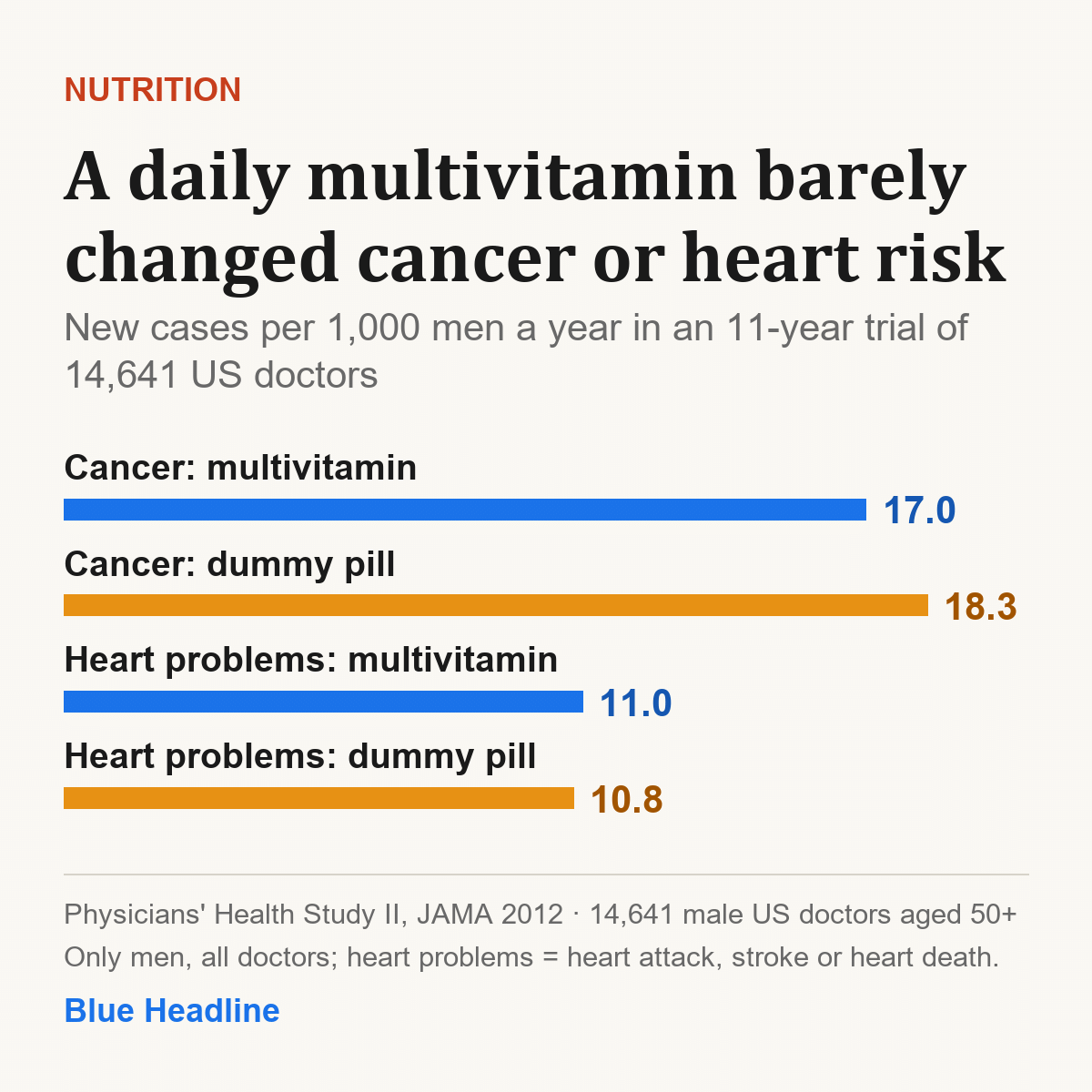
In healthy adults, multivitamins didn’t prevent heart disease or early death. They may cut cancer risk slightly. Beta-carotene pills raised lung cancer risk.
The newest big study: no longer life
In 2024, US government researchers pooled three large studies of 390,124 healthy adults. They followed them for up to 27 years, and 164,762 died.
Daily multivitamin users had a 4% higher risk of death in the first 12 years. In the last 15 years, the difference was too small to be sure of.
I wouldn’t read that as proof of harm. But it’s certainly no benefit.
Multivitamin users also looked healthier on paper. They smoked less (11.0% vs 13.0%) and were more often college educated (42.0% vs 37.9%).
That “healthy user” effect can make supplements look better than they are. This study adjusted for it carefully, and still found no gain.
Can multivitamins help memory?
This is the newest, most interesting part of the story.
The COSMOS trial gave a daily multivitamin or a dummy pill to US adults aged 60 and over. Three smaller studies inside it tested memory and thinking.
Pooling the 5,203 people in those studies, the multivitamin group did slightly better. The researchers said the effect was like slowing the ageing of thinking skills by about 2 years.
That sounds big, but the change on the tests was small. And a 3-year study of 2,262 people didn’t find fewer new cases of mild memory problems, though it was too small to be sure.
The trial used Centrum Silver, and its maker supplied some of the pills. Most participants were white.
Other brands may not work the same way.
| Memory study | People | Result |
|---|---|---|
| COSMOS, 3 studies pooled | 5,203 | Slightly better memory and thinking, like 2 years less ageing |
| COSMOS-Mind | 2,262 | No clear drop in new cases of mild memory problems over 3 years |
Can multivitamins be harmful?
A standard multivitamin at the label dose is unlikely to hurt most people. The risks come mainly from high-dose single supplements.
The Task Force review found:
- Beta-carotene raised lung cancer risk in people already at high risk, such as smokers.
- Vitamin A was linked to hip fractures.
- Vitamin E was linked to bleeding strokes.
- Vitamin C and calcium were linked to kidney stones.
More isn’t better. Taking several products at once can push some nutrients past safe limits.
What earlier research found
Doctors’ trial: heart results
The Physicians’ Health Study II heart results were published in JAMA in 2012. Over 11.2 years, there were 1,732 major heart events.
A daily multivitamin made no difference to heart attacks, strokes or heart deaths.
Doctors’ trial: cancer results
The cancer results of the same trial found 2,669 cancers. The multivitamin group had 8% fewer.
Prostate cancer rates barely moved.
Memory in older adults
The COSMOS memory analysis, published in 2024, is the source of the “2 years” figure. Its in-person study of 573 people found a clear benefit only for memory, not for overall thinking.
Long-term survival
The 2024 study of 390,124 adults in JAMA Network Open found no survival benefit. It was funded by the US National Institutes of Health, and the authors reported no conflicts.
How much should you trust this?
Strong. For heart disease and early death, large trials and huge studies agree.
What makes it convincing
- The main review pooled 84 studies with 739,803 people.
- A blinded trial followed 14,641 men for 11 years.
- A study of 390,124 adults followed people for up to 27 years.
- The results point the same way.
What makes me cautious
- The doctors’ trial included only male doctors aged 50 or older.
- The cancer benefit rests on just 4 trials.
- The memory results are new and come from one trial.
- Many studies included mostly white participants.
| The research shows | The research does not show |
|---|---|
| No clear protection against heart disease or early death | That vitamins don’t matter for health |
| A small cut in cancer risk with multivitamins | That everyone should take one for cancer |
| Beta-carotene pills can cause harm | That a standard multivitamin is dangerous |
| A possible small memory benefit in older adults | That multivitamins prevent dementia |
What this means for you
- Food first. Fruit, vegetables, whole grains, beans and fish give you nutrients plus fibre and much more.
- If you could become pregnant, take folic acid. The CDC advises 400 micrograms a day to help prevent birth defects of the brain and spine.
- If a test shows you’re low in something, treat that. A targeted supplement makes more sense than a general one.
- Skip beta-carotene pills, especially if you smoke or used to.
- If you take a multivitamin, it’s probably fine. Stick to the label dose and tell your doctor, as some supplements affect medicines.
In this BBC Reel video, experts explain the benefits and risks of vitamin pills:
What we still don’t know
- Do multivitamins really protect memory? COSMOS needs repeating in other groups and with other products.
- Do they help women’s cancer risk? The best cancer trial included only men.
- Who benefits most? People with poor diets or absorption problems may gain more than well-fed adults.
- Which nutrients matter? A multivitamin mixes many, so the active ones are unclear.
My take: a small habit, not a health plan
What I like about this research is how clear it is. For heart disease and early death, a daily multivitamin doesn’t do much.
I’m less sure about the memory findings. They’re interesting, but they come from one trial using one product.
If you enjoy your multivitamin, it’s unlikely to hurt you. Just don’t count on it to protect your heart, and spend the effort on your plate instead.
Main source: Vitamin and Mineral Supplements for the Primary Prevention of Cardiovascular Disease and Cancer (JAMA, 2022)
Last reviewed: 2026-10-15
Covers: Do multivitamins work, heart disease, cancer, death, memory, harms of single supplements, who may need supplements
Evidence: Strong — large trials and long studies agree there’s no protection against heart disease or early death; memory results are newer
Comments
No comments yet. What did you think?