Intermittent fasting is hugely popular. Skip breakfast, eat in an 8-hour window, or fast two days a week.
Fans say it melts fat and fixes your metabolism. Critics say it’s just dieting with a clock.
A big 2025 review of 99 trials gives a fairly clear answer. Here’s what it found, which type worked best, and who should be careful.
- Intermittent fasting does help people lose weight, compared with eating as normal.
- But in most trials, it worked about as well as ordinary calorie cutting, not better.
- The best method is the one you can stick with.
Does intermittent fasting work?
Yes, for weight loss. But mostly because it helps people eat less, not because of anything magic about the timing.
In a 2025 review of 99 randomised trials, every fasting method helped people lose weight compared with eating as normal. Ordinary calorie cutting did too.
The differences between them were small. Only one method, alternate-day fasting, beat calorie cutting, and only by about 1.3 kg (2.8 lb).
The main types of intermittent fasting
There’s no single “intermittent fasting” diet. These are the three main types the researchers looked at:
| Type | How it works | Example |
|---|---|---|
| Time-restricted eating | Eat only within a set window each day | 16:8, eating between noon and 8 p.m. |
| Whole-day fasting | Fast or eat very little on some days of the week | The 5:2 diet: 2 fasting days a week |
| Alternate-day fasting | Fast or eat very little every other day | Fast one day, eat normally the next |
The researchers compared these with ordinary calorie cutting (eating less every day) and with eating as normal.
What the research shows
A review of 99 trials
The main source is a 2025 review in The BMJ, led by researchers at Harvard and the University of Toronto.
The team pooled 99 randomised trials with 6,582 adults.
Most had overweight or obesity, and about two-thirds were women. The typical age was 45.
It was commissioned to help update the European Association for the Study of Diabetes guidelines on diet.
What they found
Compared with eating as normal, every diet led to some weight loss:
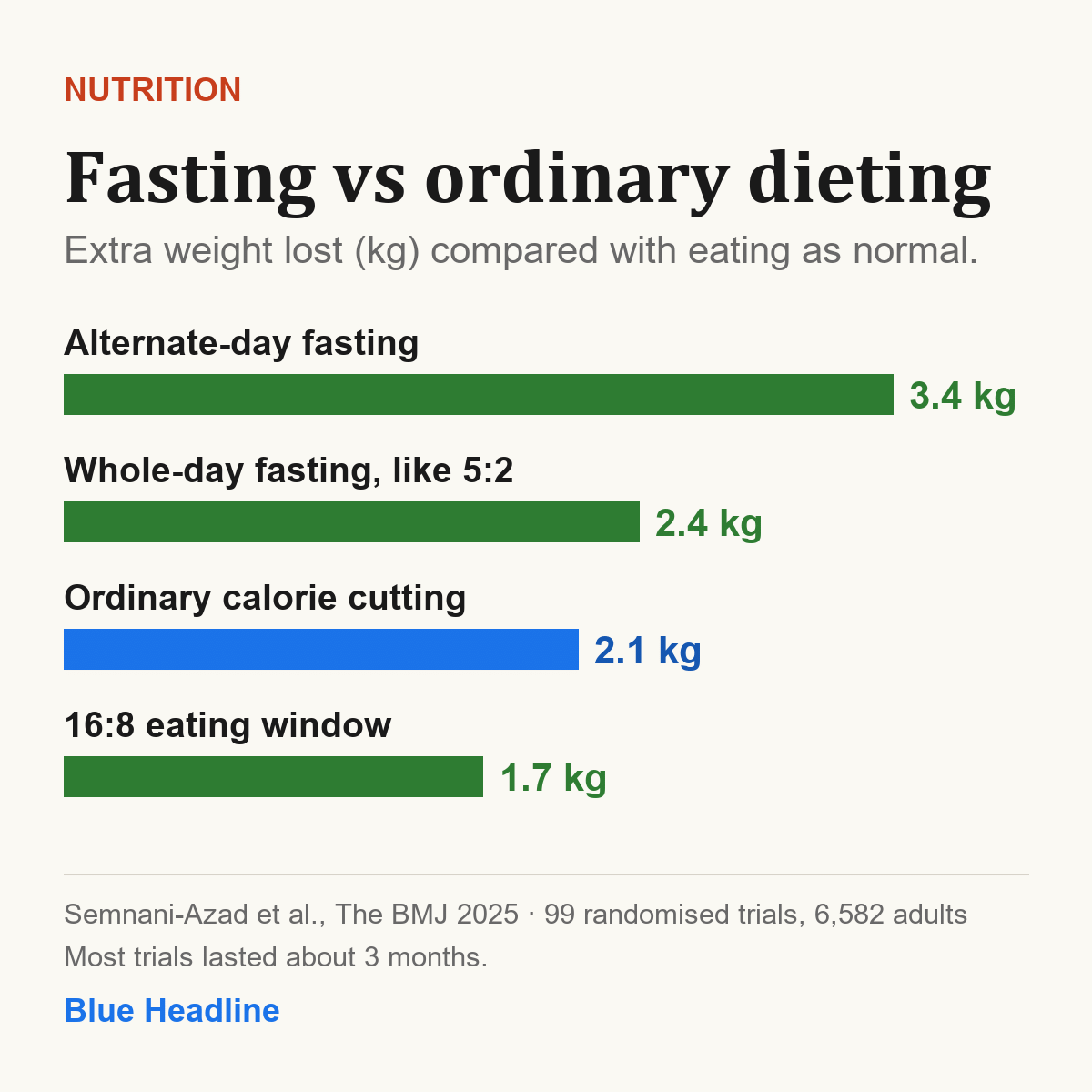
Alternate-day fasting came out on top, at 3.4 kg (7.5 lb) more than eating as normal. Time-restricted eating, like 16:8, came last at 1.7 kg (3.8 lb).
Only alternate-day fasting beat calorie cutting. But the authors called the gap of 1.3 kg trivial, because it was below the 2 kg they count as meaningful.
| Diet | Extra weight lost vs eating as normal | Certainty of evidence |
|---|---|---|
| Alternate-day fasting | 3.4 kg (7.5 lb) | High |
| Whole-day fasting, such as 5:2 | 2.4 kg (5.2 lb) | High |
| Ordinary calorie cutting | 2.1 kg (4.7 lb) | Moderate |
| Time-restricted eating, such as 16:8 | 1.7 kg (3.8 lb) | Moderate |
What about longer trials?
This is the important part. Most trials were short: the typical one lasted 12 weeks, and only 5 lasted a year or more.
In the 17 trials that lasted at least 24 weeks, all the diets still beat eating as normal. But no fasting method beat calorie cutting.
The authors’ reading: the small edge for alternate-day fasting may only last in the short term.
Blood sugar, cholesterol and blood pressure
All the diets slightly lowered fasting blood sugar and insulin resistance, compared with eating as normal. The changes were trivial.
None of them changed HbA1c, a measure of long-term blood sugar. None changed “good” HDL cholesterol either.
Alternate-day fasting lowered some blood fats a little more than time-restricted eating, but most of that evidence was indirect.
Side effects
Of the 56 trials that reported side effects, 27 found none in the fasting groups.
Most of the rest were mild: constipation, nausea, hunger, diarrhoea and dizziness. One person had low blood sugar and fell.
The catch
Here’s what I’d keep in mind. Most trials were short and small, with a typical size of 46 people.
Sticking with fasting got harder over time. In one year-long trial, people followed whole-day fasting on 74% of days at 6 weeks, but only 22% at a year.
For comparison, the authors note that weight-loss drugs like semaglutide typically cut 10% to 15% of body weight. Fasting results were much smaller.
Who funded it
The review was commissioned and funded by the diabetes nutrition group of the European Association for the Study of Diabetes, with Canadian public research funding.
Some authors reported past funding or fees from food industry groups, including sugar and honey organisations.
Intermittent fasting helps people lose weight compared with eating as normal. But in a review of 99 trials, it mostly worked about as well as ordinary calorie cutting. The small edge for alternate-day fasting faded in longer trials.
Is intermittent fasting safe?
For most healthy adults in these trials, side effects were mild. But there are a few things worth knowing.
What about muscle?
When you lose weight, you lose some muscle and other lean tissue too. A 2024 review of 28 trials compared fasting diets with calorie cutting.
Weight loss was similar. But fasting diets led to slightly more loss of lean (fat-free) mass, by about 0.2 kg.
That’s a small amount. But it’s a good reason to eat enough protein and keep active if you try fasting.
What about the “heart death” headline?
In 2024, a study made headlines by linking an 8-hour eating window to a 91% higher risk of death from heart disease.
It was preliminary research presented at an American Heart Association conference. It used data from about 20,000 US adults.
But people reported what they ate on just two days. And the study can’t show that the eating window caused the deaths, as the senior author said.
It’s a reason for more research, not for panic. The trials above didn’t track heart attacks or deaths, so the long-term question is still open.
Who should be careful
The trials in the 2025 review didn’t include children or pregnant women. So there’s no good evidence for fasting in those groups.
If you take medicine for diabetes, fasting can make your blood sugar drop too low. Talk to your doctor first.
If you’ve had an eating disorder, talk to a doctor before trying any fasting diet.
What earlier research found
A 16:8 diet was no better than three meals a day
In 2020, a US trial called TREAT gave 116 adults with overweight or obesity either a 16:8 eating window or three structured meals a day.
After 12 weeks, the 16:8 group lost 0.94 kg and the meal group 0.68 kg. The difference wasn’t significant.
A year of fasting plus calorie cutting
A 2022 trial in China, published in the New England Journal of Medicine, followed 139 adults with obesity for a year.
Everyone cut calories. Half also ate only between 8 a.m. and 4 p.m.
The time-limited group lost 8.0 kg and the others 6.3 kg. That gap wasn’t statistically significant.
No calorie counting needed?
A 2023 trial in Chicago gave 90 adults with obesity either an 8-hour eating window with no calorie counting, or a 25% calorie cut.
After a year, both groups had lost weight compared with a control group: 4.6 kg for the eating window and 5.4 kg for calorie cutting. The two diets didn’t differ.
Both groups ended up eating about 400 fewer calories a day. That’s likely why both worked.
A review of 28 trials
The 2024 review on muscle also looked at weight. Across 28 trials, fasting diets and calorie cutting led to similar weight loss.
The difference was 0.42 kg in favour of fasting, which could have been chance.
How it fits together
The research keeps landing in the same place. Fasting works about as well as other ways of eating less, but not much better.
For people who find calorie counting hard, an eating window may be an easier way to do the same thing.
How much should you trust this?
Strong. The main finding comes from 99 randomised trials, and other reviews and year-long trials agree. But the long-term evidence is thin.
What makes it convincing
- It pooled randomised trials, the best way to test a diet.
- Over 80% of the trials were judged at low risk of bias.
- The certainty of evidence for weight was moderate to high.
- Year-long trials found the same pattern.
What makes me cautious
- The typical trial lasted only 12 weeks.
- Only 5 trials lasted a year or more.
- Many trials were small.
- The trials measured weight and blood tests, not heart attacks or how long people lived.
| The evidence shows | The evidence does not show |
|---|---|
| Fasting helps people lose weight vs eating as normal | That fasting beats calorie cutting in the long run |
| Alternate-day fasting had a small short-term edge | That the timing of meals matters more than how much you eat |
| Most side effects were mild | That fasting is safe for everyone |
| People found fasting harder to stick with over time | What happens after many years |
What this means for you
- Pick the method you can keep up. In the long run, the type of fasting mattered less than sticking with it.
- Don’t expect magic. Fasting seems to work mainly by helping you eat less.
- If counting calories is hard, try a window. An 8-hour window cut calories by about as much as counting did.
- Eat enough protein and stay active. It may help protect muscle while you lose weight.
- Expect some hunger. Hunger, nausea and constipation were among the most reported side effects.
- Check with your doctor first if you take diabetes medicine, are pregnant, or have had an eating disorder.
For people with diabetes, the US National Institutes of Health advises talking to a doctor before trying intermittent fasting.
If you’re curious whether meal timing matters at night too, we looked at whether eating before bed is bad for you.
In this short video, Mayo Clinic looks at whether intermittent fasting raises heart disease risk:
What we still don’t know
- Does it work for years? Very few trials lasted even a year.
- Does it prevent disease? No trial has tested whether fasting cuts heart attacks or deaths.
- Does the time of day matter? One small study in men with prediabetes found a morning eating window helped, but it isn’t settled.
- Who does it suit best? It’s not clear which people do better with fasting than with calorie cutting.
My take: it’s a tool, not a miracle
What I like about this review is that it compared everything at once: three types of fasting, calorie cutting and normal eating.
I’m less convinced by claims that fasting has special fat-burning powers. In the long run, it did about as well as eating less in any other way.
So my reading is simple. If an eating window helps you eat less without feeling miserable, it’s a good tool.
If it makes you hungry and grumpy, ordinary calorie cutting works just as well.
Last reviewed: 2026-10-13
Covers: Whether intermittent fasting works, types of fasting (16:8, 5:2, alternate-day), fasting vs calorie cutting, side effects, muscle loss, the 2024 heart death headline, who should be careful
Evidence: Strong — a review of 99 randomised trials with mostly moderate to high certainty, but few trials lasted a year
Comments
No comments yet. What did you think?