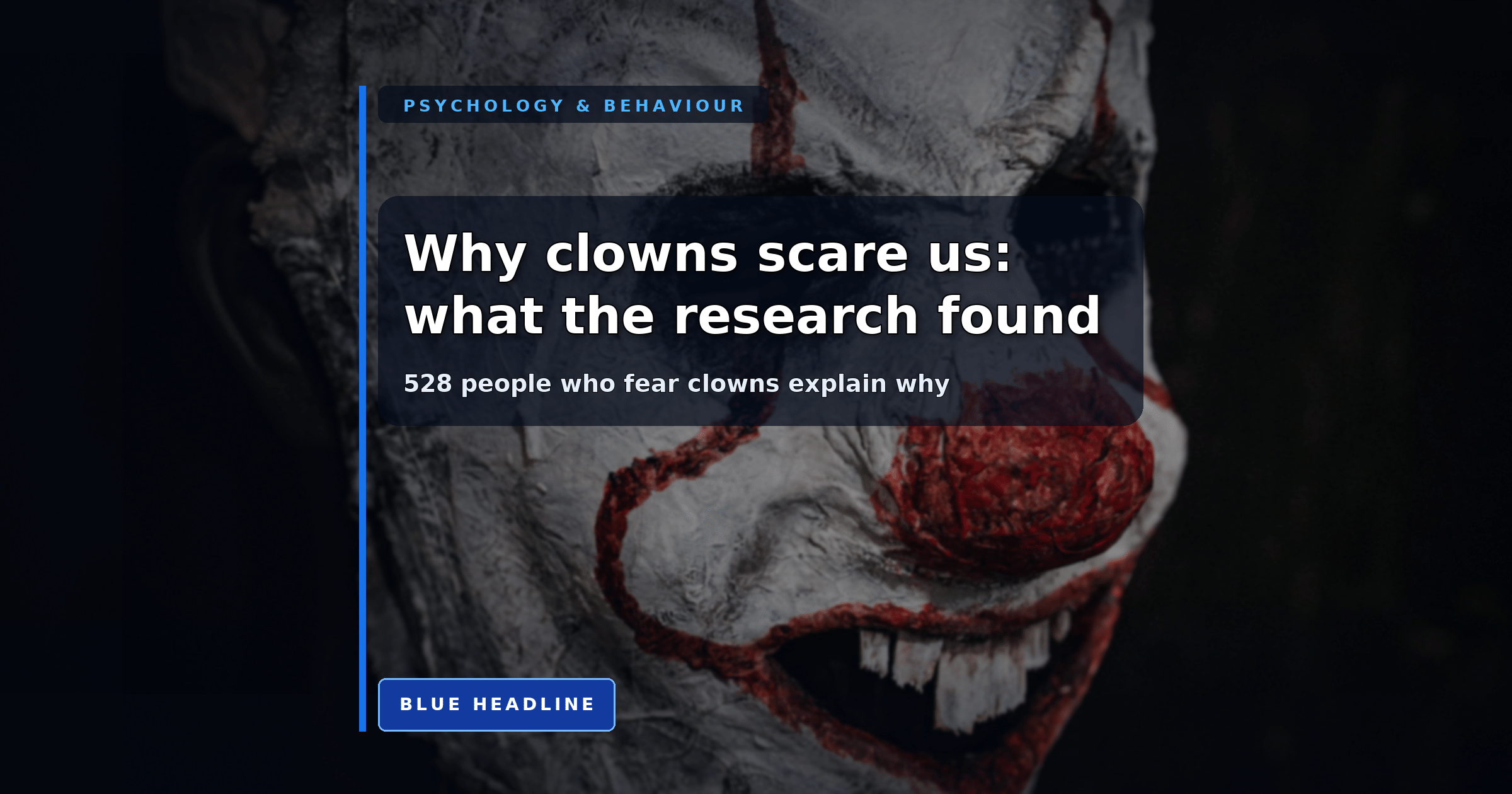
Clowns are meant to be funny. Big shoes, red noses, balloon animals.
Yet for a surprising number of people, a clown is the stuff of nightmares.
So why are people afraid of clowns? Until recently, nobody had properly asked the people who fear them.
A study from the University of South Wales did just that. The answers were not what most people would guess.
- In a survey of 987 adults, just over half said they had at least some fear of clowns.
- The top reasons were not being able to read a clown’s face, scary media portrayals and unpredictable behaviour.
- A bad personal experience with a clown came last of eight possible explanations.
Why are people afraid of clowns?
The short answer: we can’t tell what a clown is feeling or planning.
Their make-up hides real facial expressions behind a painted smile. Add unpredictable behaviour and decades of killer-clown films, and many people feel on edge.
The fear even has a name: coulrophobia. It isn’t listed as its own diagnosis, but the DSM-5 counts “costumed characters” as a type of specific phobia.
The study: asking people who fear clowns
Who took part
The study, published in Frontiers in Psychology in 2023, surveyed 987 adults online in late 2019.
Of those, 528 people, or 53.5%, said they were at least slightly afraid of clowns. They became the study group.
| Detail | Figure |
|---|---|
| Adults surveyed | 987 |
| People with some fear of clowns | 528 (53.5%) |
| Women in the fearful group | 85% |
| Countries represented | 52 |
| Age range | 18 to 72 |
What they were asked
The researchers built a new questionnaire with eight possible causes of clown fear, drawn from earlier research.
People rated statements such as “I cannot read a clown’s facial expression” on a 7-point scale, from totally disagree to totally agree.
What the study found
The top reasons
Four causes stood out, with the highest average agreement.
| Rank | Possible cause | Average score (out of 7) |
|---|---|---|
| 1 | Hidden emotional signals | 5.20 |
| 2 | Negative media portrayals | 5.03 |
| 3 | Unpredictable behaviour | 4.96 |
| 4 | The “uncanny valley” effect | 4.78 |
| 7 | Learning it from family | 2.78 |
| 8 | A frightening experience with a clown | 2.65 |
Hidden faces and painted smiles
The top-ranked cause was hidden emotional signals. Make-up masks the real expression underneath, so a smiling clown could be angry.
That creates uncertainty about whether a clown means harm. Older participants agreed with this more strongly.
Films, books and news stories
Media came second. Killer clowns run from the 1892 opera Pagliacci to Stephen King’s novel It and its film versions.
The authors note that killer clowns have had a real-life counterpart too: the serial killer John Wayne Gacy.
The near-human look
The “uncanny valley” describes the unease we feel at things that look almost, but not quite, human. Think dolls, masks and some computer-animated faces.
A clown’s exaggerated make-up may push a real face into that territory.
People who fear clowns mostly blamed hidden emotions, scary media and unpredictable behaviour. A bad personal encounter came last of eight causes.
Not usually a bad experience
Perhaps the biggest surprise was what came last. Few people traced their fear to a frightening encounter with an actual clown.
The authors conclude that direct bad experiences alone can’t explain most clown fear.
A gut reaction too
A statistical analysis grouped many answers into a single cluster of strong physical reactions. These included a racing heart, tense muscles and feeling sick.
The authors suggest part of the fear may be an instinctive “gut” response, a bit like some people’s reaction to snakes or spiders.
When the fear becomes a phobia
A 2022 study in the South African Journal of Psychiatry looked at the more serious end. Researchers surveyed members of an online support group for people who fear clowns.
| Detail | Figure |
|---|---|
| People who responded | 95 |
| Women | 83.2% |
| Average age when the fear began | 9 |
| Met the full criteria for a specific phobia | 9.5% |
| Had palpitations around clowns | 43.9% |
| Had never had treatment | 96.8% |
Most people, 89.5%, said their symptoms had never gone away since they started. And 69.5% couldn’t name a specific event that triggered the fear.
Of those who could, the most common trigger was the film It. Some respondents also reported diagnoses such as depression and other anxiety conditions.
Fear, disgust, or both
Not everyone who hates clowns is simply scared. Almost 18% felt only fear, while 15.8% felt only disgust.
Most felt a mix of the two. Those who felt only fear had more physical symptoms, such as a racing heart, than those who felt only disgust.
Why the results need caution
Who took part
Both studies relied on volunteers who chose to answer online surveys. The larger one was 85% women, and the smaller one had a response rate of about 1.2%.
So the results may not reflect everyone who fears clowns.
Self-report only
People were asked to explain their own fear. But the origins of a fear can be hard to remember accurately, especially if it began in childhood.
The larger study also couldn’t say who had a clinical phobia and who was just uneasy.
What earlier research found
Clowns rated the creepiest job
A 2016 study on the nature of creepiness asked 1,341 people to rate how creepy different occupations were. Out of 21 jobs, clown came top.
A peculiar smile, bulging eyes and very pale skin were among the features linked to creepiness. Clown make-up exaggerates exactly those.
Clowns in hospitals
Not every child fears clowns. A 2016 meta-analysis in the European Journal of Pediatrics pooled trials of clowns visiting children in hospital.
It found hospital clowns reduced anxiety in children and their parents. The paper later received a correction.
How it fits together
Most people around clowns are fine, and some clearly benefit. But for a sizeable minority, a clown’s hidden face and unpredictable behaviour set off real alarm.
How much should you trust this?
Early. The large study is the first to directly ask about the causes of clown fear, but it relies on self-report in an unrepresentative sample.
What makes it convincing
- It’s the first study designed to test competing explanations for clown fear.
- It included 528 people with the fear, from 52 countries.
- Its questionnaire was internally consistent, meaning the items hung together well.
- A separate study of people with more severe fear found a similar picture.
What makes me cautious
- Most participants were women recruited online.
- People reported their own reasons, which can be unreliable.
- The new questionnaire hasn’t yet been tested in other studies.
- Neither study can prove what actually causes the fear.
| The evidence shows | The evidence does not show |
|---|---|
| Hidden emotions and scary media were the top reasons given | That films alone create the fear |
| Bad personal experiences were rarely blamed | That clown fear is never caused by an incident |
| Some people have severe, lasting symptoms | How common clinical coulrophobia is |
| Hospital clowns can calm many children | That clowns are frightening to most people |
What this means for you
- If clowns unsettle you, you’re far from alone. Just over half of people in the large survey reported some fear.
- Kids’ parties: ask first. A child, or adult, may find a clown more scary than fun.
- A phobia can be treated. The NHS says talking therapies such as cognitive behavioural therapy (CBT) can help.
- See a GP if it affects your life. The NHS advises this if you think you have a phobia and symptoms are affecting you.
The NHS guide to phobias explains symptoms, self-help and treatment.
If anxiety or low mood is becoming too much, please talk to someone.
In the US, call or text 988. In the UK and Ireland, you can call Samaritans on 116 123, any time.
Elsewhere, Find a Helpline lists free services. If someone is in immediate danger, call emergency services.
In this short video from Seeker, you can see the science behind our fear of clowns:
What we still don’t know
- How fear level links to cause. The authors say this is the focus of their next research.
- Does early trauma play a part? The authors suggest it could, but didn’t test it.
- Which part of the look matters most? Testing different make-up styles could answer this.
- How common is clinical coulrophobia? Estimates vary widely.
- Do treatments work for it? Almost nobody in the support-group study had been treated.
My take: it’s the face, not the clown
What I like about this study is that it asked the people who are actually afraid. And the answer is more interesting than “they saw a scary film”.
I’m less convinced the numbers apply to everyone. The sample was mostly women recruited online, and people’s own explanations can be shaky.
Still, the core idea makes sense. We read faces to judge whether someone is safe, and a clown’s painted smile takes that away.
Paper: Fear of clowns: An investigation into the aetiology of coulrophobia
Published: Frontiers in Psychology, 2023-02-02
Study: Online survey with a new questionnaire on the origins of clown fear
Who: 987 adults surveyed; 528 with some fear of clowns, from 52 countries
Funding: Not stated in the paper; the authors declared no competing interests
Evidence: Early — the first study of its kind, but based on self-report in a mostly female, online sample
Comments
No comments yet. What did you think?