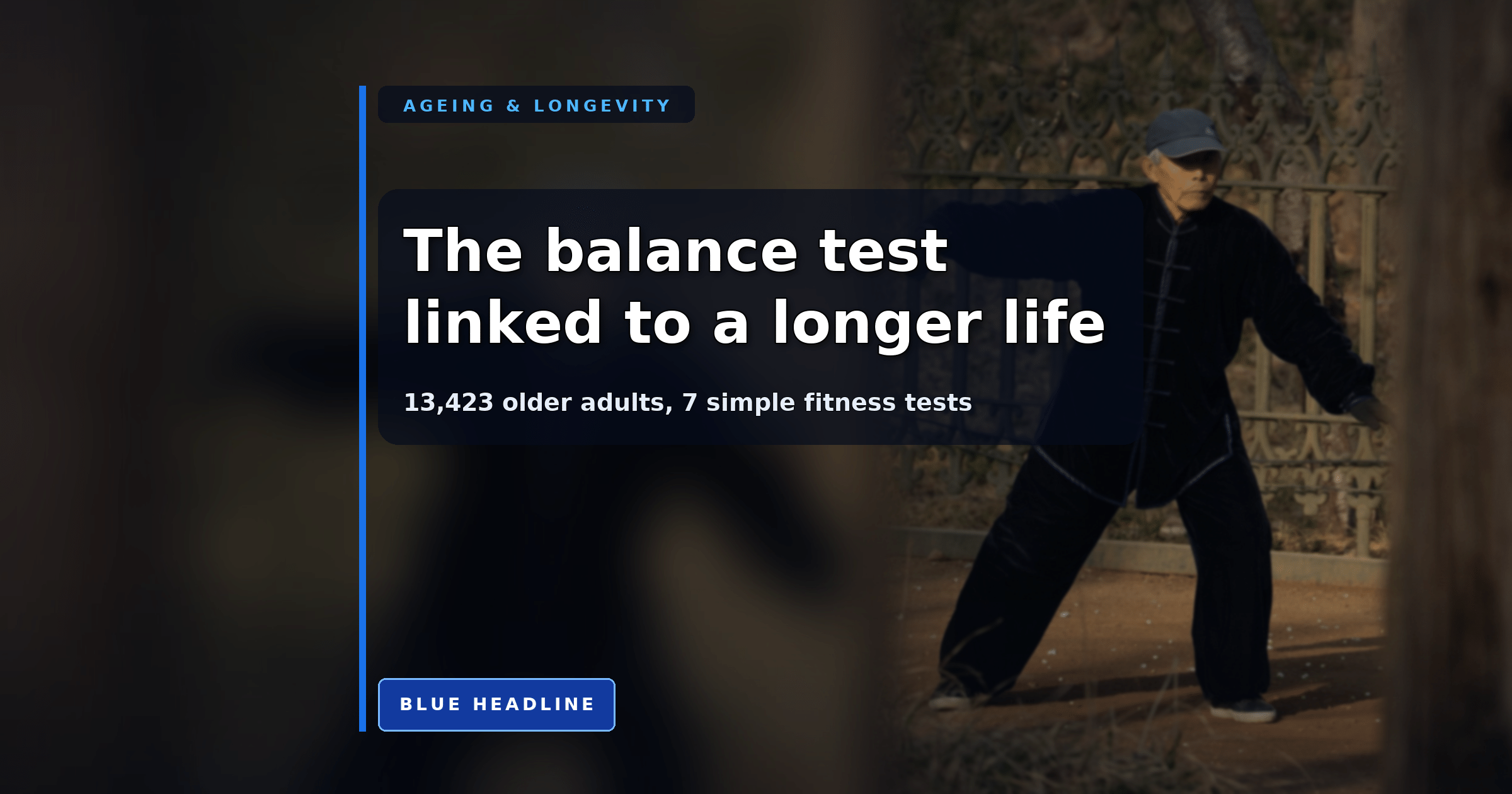
Doctors usually judge an older person’s health by their list of diagnoses. Blood pressure, diabetes, heart disease, and so on.
A large new study from Taiwan suggests something simpler may add a lot. How well you can stand on one leg, rise from a chair, or walk around a cone.
In 13,423 adults aged 65 and over, the best performers on simple fitness tests were far less likely to die within seven years.
- The best performers on a quick walking and turning test had a 59% lower risk of death than the worst, after adjusting for health conditions.
- Balance, leg strength and stamina showed the strongest links. Flexibility showed the weakest.
- Most of the difference was between the least fit people and everyone else.
Can a balance test predict how long you’ll live?
It can’t predict your personal lifespan. But in large studies, poor balance is linked to a higher risk of dying in the following years.
This study tested balance two ways. One was standing on one leg with eyes open, for up to 30 seconds.
The other was the 8-foot up-and-go test. You rise from a chair, walk about 2.4 metres around a cone, come back and sit down.
These tests are quick, cheap and need almost no equipment. That’s why researchers think they could be useful in everyday checkups.
The study: 13,423 older adults in Taiwan
Who took part
The study, published in JAMA Network Open in August 2026, used Taiwan’s national fitness survey. People aged 65 and over were tested at 46 stations around the country between 2015 and 2016.
Researchers linked the results to national health insurance and death records, up to the end of 2022.
People with dementia, stroke, a past amputation or certain serious illnesses were left out. People over 90 were excluded too.
| Detail | Figure |
|---|---|
| People | 13,423 |
| Average age | 72.9 |
| Women | 62.5% |
| Median follow-up | 7 years |
| Deaths | 1,631 (12.2%) |
The seven tests
Trained examiners ran the Senior Fitness Test, a standard set of seven checks.
| Test | What it measures |
|---|---|
| 2-minute step test | Stamina (stepping on the spot) |
| 30-second arm curl | Arm strength |
| 30-second chair stand | Leg strength |
| Back scratch | Shoulder flexibility |
| Chair sit-and-reach | Leg and lower back flexibility |
| One-leg stance | Balance |
| 8-foot up-and-go | Balance and agility |
The team split people into five equal groups for each test, by sex. Then they compared the best group with the worst.
What the study found
Every test was linked to survival
On all seven tests, people who scored better were less likely to die. The researchers adjusted for age, sex, activity levels, weight, income, education and ten common diseases.
Here’s how the best fifth compared with the worst fifth:
| Test | Lower risk of death, best vs worst |
|---|---|
| All seven combined | 61% lower |
| 8-foot up-and-go | 59% lower |
| One-leg stance | 50% lower |
| 30-second chair stand | 45% lower |
| 2-minute step test | 42% lower |
| 30-second arm curl | 37% lower |
| Chair sit-and-reach | 21% lower |
These are relative risks. They don’t mean a fit person has a 59% chance of anything.
Balance and leg strength stood out
The balance tests showed the strongest links. Leg strength and stamina came next.
The authors think this may be about falls. Poor balance and weak legs raise the risk of falls and hip fractures, which can lead to hospital stays and death.
Men and women differed a little
In men, balance and stamina showed the strongest links. In women, leg strength mattered about as much as balance.
Getting out of the bottom group matters most
Most of the difference in death risk sat between the least fit fifth and everyone else.
For some tests, the risk flattened out at a certain level. For men, that was about 15 chair stands in 30 seconds.
For women, it was an up-and-go time of about 7 to 8 seconds.
The authors said this supports focusing help on the least fit older adults.
Older adults who did well on quick balance, leg strength and stamina tests were much less likely to die over seven years. The biggest gap was between the least fit and everyone else.
Why the result needs caution
This is an observational study. It shows a link, not proof that improving your score will help you live longer.
Illness can make people less fit before it’s diagnosed. So some of the link could run the other way, from poor health to poor fitness.
Fitness was measured only once. And people had to be well enough to visit a testing station, so the group was likely healthier than average.
The survey didn’t record smoking, a major cause of death. Body fat and muscle weren’t measured directly either.
The study was funded by Taiwan’s National Science and Technology Council, and the authors reported no conflicts of interest.
What earlier research found
The 10-second balance test
A 2022 study in the British Journal of Sports Medicine asked 1,702 people aged 51 to 75 to stand on one leg for 10 seconds.
About one in five couldn’t do it. Over a median of seven years, 17.5% of them died, compared with 4.6% of those who could.
After adjusting for age, sex, weight and health conditions, failing the test was linked to an 84% higher risk of death.
Walking speed
A 2011 study in JAMA pooled data from 34,485 older adults in nine studies. Faster walking speed was linked to longer survival across the whole range of speeds.
Walking speed predicted survival about as well as a list of age, health conditions, smoking and blood pressure.
How it fits together
Different teams, countries and tests point the same way. How well an older person can move tells us something about their health that a diagnosis list can miss.
How much should you trust this?
Promising. The study is large and careful, and it fits earlier research. But it can’t prove cause and effect.
What makes it convincing
- It’s large, nationwide and followed people for seven years.
- Trained examiners used a standard set of tests.
- Death records were nearly complete, so few people were lost.
- The results match earlier studies of balance and walking speed.
What makes me cautious
- Observational studies can’t rule out other explanations.
- Healthier people were more likely to take part.
- Smoking wasn’t recorded.
- Fitness was tested only once.
- It’s one country, so results may differ elsewhere.
| The study shows | The study does not show |
|---|---|
| Fitter older adults had a lower risk of death | That improving your score will add years |
| Balance and leg strength had the strongest links | Your personal life expectancy |
| The biggest gap was among the least fit | That flexibility doesn’t matter for daily life |
| Simple tests carry useful health information | That these tests should replace a doctor’s assessment |
What this means for you
- Test yourself safely. Try standing on one leg next to a kitchen counter you can grab. Don’t try it if you’re unsteady or have had a recent fall.
- Train balance and strength. The NHS advises people over 65 to work on strength, balance and flexibility at least 2 days a week.
- Keep moving most days. The NHS also recommends at least 150 minutes of moderate activity a week, and being active every day.
- Practise rising from a chair. Standing up and sitting down without using your hands builds leg strength.
- Talk to your doctor if your balance is poor, especially if you’ve fallen or feel dizzy.
The NHS physical activity guidelines for older adults include simple strength and balance exercises.
In this short video, Mayo Clinic explains what standing on one leg can reveal about ageing:
What we still don’t know
- Does improving your score help you live longer? Only a trial could show that.
- Why is balance so strongly linked? Falls are one idea, but it isn’t proven.
- Do the results apply outside Taiwan? Other populations need testing.
- What about frailer people? The study left out many people with serious illness.
- Which causes of death are linked? The study only looked at deaths from any cause.
My take: a two-minute check worth doing
What I like about this study is how practical it is. These tests take minutes, need a chair and a stopwatch, and say something real about health.
I’m less convinced by any suggestion that a test score sets your lifespan. The study shows links, not destiny.
Still, if standing on one leg feels hard, that’s a useful nudge. Balance and leg strength can be trained, and the NHS recommends doing just that.
Paper: Physical Fitness and All-Cause Mortality in Older Adults
Published: JAMA Network Open, 2026-08-10
Study: Nationwide cohort study with seven standard fitness tests, followed for a median of 7 years
Who: 13,423 adults aged 65 and over in Taiwan
Funding: Taiwan’s National Science and Technology Council; the authors reported no conflicts of interest
Evidence: Promising — a large, careful cohort, but it shows links rather than proof
Comments
No comments yet. What did you think?