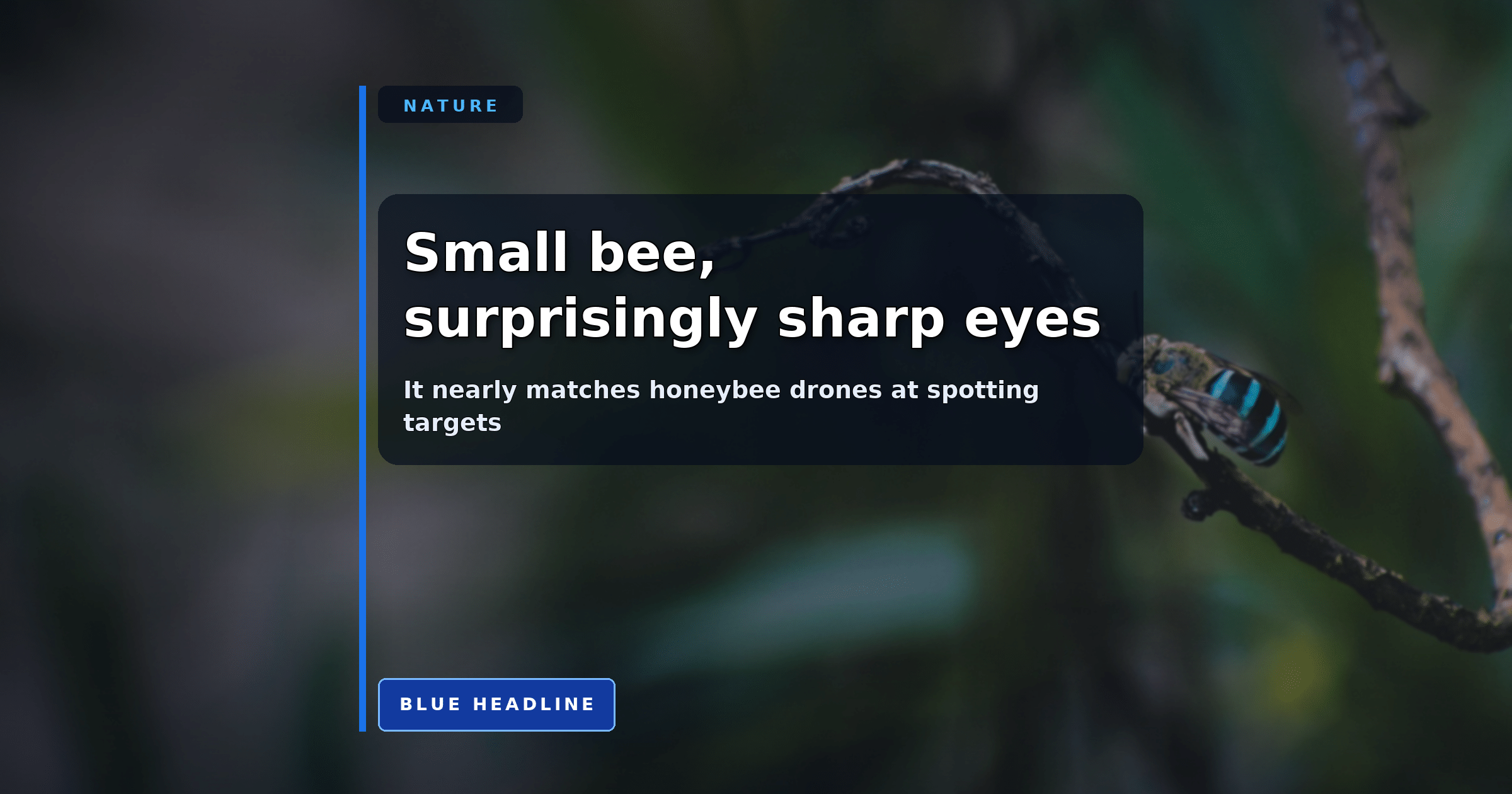
When we think of bees, most of us picture the honeybee. It’s also the bee scientists have studied most.
But there are more than 20,000 described bee species. Most of them live alone, not in hives.
A new study looked inside the eyes of some of these overlooked bees. It found that a small Australian bee sees tiny moving objects about as well as a much bigger honeybee male.
The lesson goes beyond bees. Bigger eyes don’t automatically mean sharper vision.
- A small solitary bee, the blue-banded bee, detected tiny targets almost as well as honeybee drones with much larger eyes.
- Every bee tested had sharper eye cells than the honeybee workers we usually study.
- Different bees reach good vision in different ways, not simply by growing bigger eyes.
How a bee’s eye works
Thousands of tiny eyes
A bee’s eye is a compound eye. It’s made of thousands of small units, each with its own lens, looking in a slightly different direction.
Each unit feeds light to light-sensitive cells. Together, they build up a mosaic picture of the world.
Why size usually matters
Compound eyes face hard trade-offs. A bigger lens gives a sharper image, but it needs more space.
More units give a finer mosaic, but that also needs a bigger eye. So scientists have long expected bigger bees to see more sharply.
Why bees need sharp eyes
Bees use vision for almost everything important. They find flowers, spot mates, navigate home and escape predators.
Some males chase females in fast flight. That means spotting a tiny moving dot against the sky.
The study: five bees, one question
Who took part
Researchers working at Lund University in Sweden and the University of Adelaide in Australia compared the eyes of five bee species. They included both males and females.
| Bee | Lifestyle | Where it lives |
|---|---|---|
| Honeybee | Lives in hives | Worldwide |
| Buff-tailed bumblebee | Lives in colonies | Europe |
| Wool carder bee | Solitary | Europe, now spread widely |
| Four-banded flower bee | Solitary | Europe |
| Blue-banded bee | Solitary | Australia |
The honeybee results came from the team’s earlier work. The other four species were measured for this study.
The blue-banded bees were caught in the Adelaide Botanic Garden and tested the same day. The European solitary bees came from gardens in Lund.
Listening to single eye cells
The team placed a very fine electrode inside individual light-sensitive cells in living bees. The bees faced a bright screen.
Small dark squares moved across the screen. The researchers recorded how each cell responded as the squares got smaller and smaller.
Two key measures
First, they measured how blurry each cell’s view was. A narrower view means sharper vision.
Second, they found the smallest moving square a cell could still detect above its own background noise.
They also measured the eyes under the microscope, including the size of the tiny light-guiding rods inside each unit.
The results: small bees, sharp eyes
Everyone beat the honeybee worker
Every species and sex tested had sharper eye cells than honeybee worker foragers.
Honeybee workers have long been the standard model for bee vision. This study suggests they’re not the sharpest-sighted bees around.
The sharpest single cells, with views about one degree wide or less, were in males of the wool carder bee and four-banded flower bee. Female blue-banded bees reached similar values.
In most species, males and females differed. Bumblebees and blue-banded bees were the exceptions.
The blue-banded bee stood out
The blue-banded bee had the best detection of small targets of any bee forager studied so far.
Its eye cells could pick up dark squares less than half a degree across. That’s roughly a 1 cm object seen from about 1.3 metres away.
| Bee | Smallest target detected |
|---|---|
| Honeybee drone (male) | 0.39° |
| Blue-banded bee, male | 0.42° |
| Blue-banded bee, female | 0.44° |
| Wool carder bee | About 0.6° |
| Honeybee worker | 0.63° |
| Bumblebee | About 0.65° |
Only honeybee drones did better, and only slightly. Drones have far bigger eyes, built for spotting a queen in flight.
The small blue-banded bee detected targets almost as small as honeybee drones could, despite having much smaller eyes.
Sharp in one direction
All the bees sampled the world more finely up and down than side to side. The vertical spacing between units was under 1 degree in every species.
The males of several solitary bees packed their eye units unusually tightly. Some even beat the famous sharp-eyed zones of flies.
The bumblebee surprise
The buff-tailed bumblebee was the largest bee tested. Yet its eyes sampled the world relatively coarsely.
Its eye cells were still sharper than honeybee workers’, but its target detection was only middling.
The authors think lifestyle explains it. Bumblebee males leave the nest to patrol, mate and forage, so they need all-round vision like the workers.
Honeybee drones are different. They stay in the hive except for mating flights, so their eyes can specialise in spotting a queen against the sky.
Why lab and field numbers differ
Behaviour studies have estimated much blurrier vision for bumblebees, around 2.4 to 6.3 degrees. The eye cells here resolved about 1.4 to 1.6 degrees.
The authors think the gap comes from testing. It’s hard to motivate a bee to respond to a very small target, and lighting conditions differ.
Why size didn’t decide it
Not eye size, not lens size
The team checked whether sharper cells simply came with bigger eyes or bigger lenses. They found no clear link.
Instead, the key factor was the width of the light-guiding rods inside each unit. Narrower rods went with sharper vision.
Different bees, different strategies
The authors describe several ways bees reach high performance:
- Blue-banded bee: sharp cells with very low background noise, so faint signals stand out.
- Wool carder bee males: extremely fine sampling and very thin rods, which sacrifice some sensitivity.
- Honeybee drones: huge lenses and a big investment in sensitivity for spotting queens.
Male wool carder bees fiercely defend territories, chasing off other insects in rapid flight. The authors suggest their thin rods might help them react faster, though that still needs testing.
Real sunlight is brighter
The screen used in the lab was much dimmer than a sunny day. Outdoors, light can be 10 to 50 times brighter.
So the bees may see small targets even better in the wild than these tests suggest.
Why sharper up and down?
Bees seem to prioritise vertical detail and economise on horizontal detail. That may help keep their eyes smaller.
The honeybee drone’s upper eye is the exception. It samples evenly in both directions, which suits scanning the sky for a queen.
What earlier research found
Honeybees see better than we thought
The same group’s 2017 study in Scientific Reports recorded from honeybee worker eyes in bright conditions.
It found eye cells about 30% sharper than earlier estimates from dark-adapted eyes. Single cells responded to objects as small as 0.6 degrees.
Body size usually rules
A 2002 study of 15 bee species measured eyes across bees of very different sizes.
It found that eye size scales with body size, and body size largely determined how many units an eye had. The spacing between units ranged from about 1.2 to 4.7 degrees.
How it fits together
The older anatomy work suggested small bees should see less sharply. The new recordings show that the eye cells themselves can make up for small size.
In other words, counting lenses isn’t enough. You also need to measure what the cells behind them actually do.
How much should you trust this?
Promising. These are direct measurements from living eye cells, but they come from a lab, with modest numbers of bees.
What makes it convincing
- It records from single eye cells directly, rather than guessing from anatomy.
- It combines physiology, optics and microscope anatomy in the same species.
- The same methods were used as in the team’s earlier honeybee work.
- The findings fit known physics of how light travels through tiny eye structures.
What makes me cautious
- Each group had only about 8 to 26 recordings.
- Honeybee data came from earlier studies, not this one.
- Only five species were compared, out of thousands.
- It measured eye cells, not how well bees actually spot and chase targets outdoors.
- The idea that thin rods give faster vision is still untested.
| This study shows | This study does not show |
|---|---|
| Small solitary bees can have very sharp eye cells | That small bees always see better than big ones |
| The blue-banded bee nearly matches honeybee drones | How the bees actually behave outdoors |
| Rod width tracks sharpness better than eye size | That rod width alone explains vision |
| Honeybee workers aren’t the sharpest-sighted bees | How the other thousands of bee species see |
What this means for you
This one won’t change your day. But it’s a good reminder that nature often solves the same problem in several ways.
- Don’t judge a bee by its size. Small, solitary bees can be highly capable animals.
- Notice the solitary bees. Most bee species live alone, nesting in soil, wood or hollow stems.
- Plant for them too. A mix of flowers and bare, undisturbed ground supports solitary bees as well as honeybees.
In this video, a bee expert explains how bees see the world, from colour to ultraviolet patterns on flowers:
What we still don’t know
- How do these bees use their sharp vision? Behaviour tests outdoors are the next step.
- Do thin rods make vision faster? The authors propose it, but haven’t tested speed yet.
- What about the other bees? Only five of more than 20,000 species were compared.
- How does colour vision fit in? This study looked at green-sensitive cells only.
- Why did bumblebees invest so little? Their generalist lifestyle may explain it.
My take: small eyes, clever wiring
What I like about this study is that it checks the eye cells directly, instead of assuming bigger means better.
The blue-banded bee result is genuinely surprising. A small bee nearly matching a honeybee drone, a specialist queen-spotter, is not what the old rules predict.
I’m cautious about how much this tells us about real life. Lab recordings of single cells are only the first step towards knowing what a bee actually sees in flight.
Still, it’s a lovely example of why studying only one “model” animal can give us a narrow picture of nature.
Published: PNAS, 2026-08-31
Study: Laboratory recordings from single eye cells, plus eye optics and microscope anatomy, in five bee species
Who: Both sexes of four newly measured bee species, compared with earlier honeybee data
Funding: Swedish Research Council and Australian Research Council; the authors declare no competing interests
Evidence: Promising — direct and careful measurements, but lab-based, with modest samples and no outdoor behaviour tests