Security teams do not just have a vulnerability problem anymore. They have a translation problem.
In 2025, the National Vulnerability Database published more than 48,000 new CVEs. The hard part is not only knowing those flaws exist. It is turning each new disclosure into production-ready detection logic before attackers get a head start.
That is why Amazon’s RuleForge story matters. It is one of the clearest examples yet of agentic AI doing security work that is messy, repetitive, high stakes, and painfully time-sensitive.
This is also a better test of agentic AI than most flashy demos. If a system can help security teams close the gap between disclosure and defense without spraying false positives everywhere, that is real operational value.
Table of Contents
The Real Bottleneck Is Not Finding Bugs. It Is Shipping Defenses Fast Enough.
Amazon says RuleForge helped its teams produce and validate detection rules 336% faster than manual methods over the final four months of 2025.
That headline number is impressive, but the more interesting detail is what the system is accelerating.
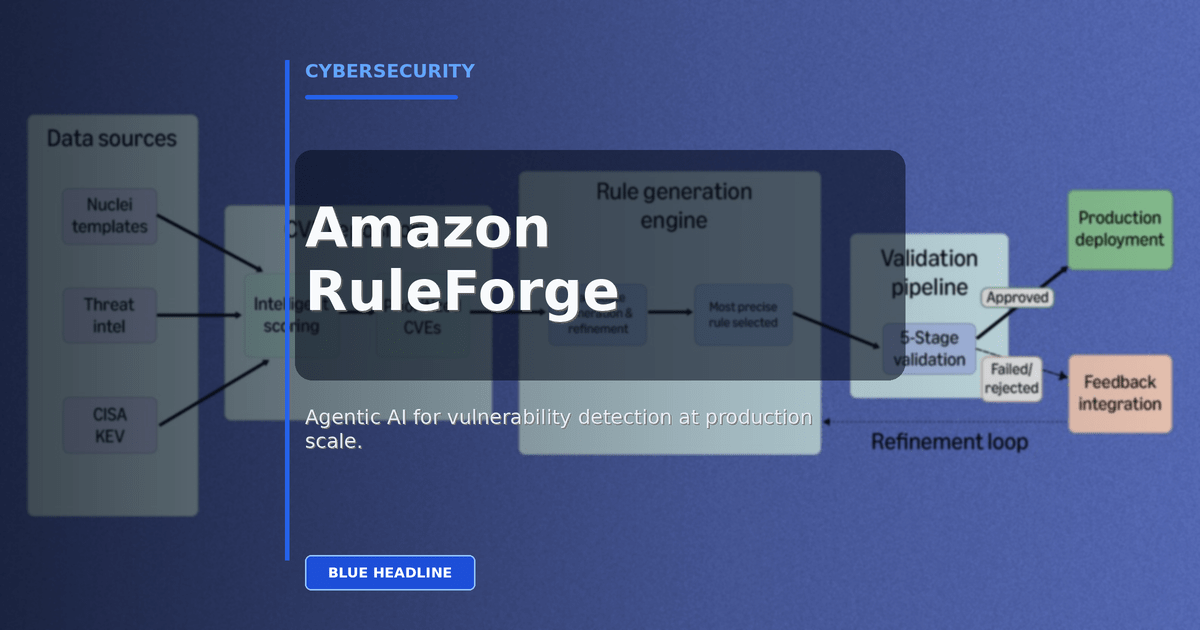
RuleForge is not just summarizing advisories or ranking risk. It is generating JSON-based detection rules from vulnerability material, validating those rules, and pushing the best candidates into human review.
“For security teams, however, knowing about new vulnerabilities isn’t enough; they must translate each disclosure into robust detection logic fast enough to protect large, complex systems.”
Source: Amazon Science
That sentence explains why this matters far beyond AWS. Many security teams already know what is broken. The real backlog lives between the alert and the defensive control.
What RuleForge Actually Changes
Before RuleForge, Amazon says detection engineering followed a classic expert workflow.
An analyst found public exploit code and studied the attack path. Then that analyst wrote detection logic, measured accuracy against traffic, tuned the rule, and sent it for peer review.
That process worked, but it forced teams to choose which CVEs deserved scarce human time.
RuleForge turns that into a staged pipeline:
- an ingestion layer pulls in public exploit material and prioritizes threats
- a generation agent proposes multiple candidate rules in parallel
- a separate evaluation agent scores those candidates
- validation stages test them against synthetic and real traffic
- a human reviewer still makes the final production decision
That last point matters. RuleForge is not replacing analysts with an autonomous security oracle. It is shifting analysts from rule authorship toward review, supervision, and final judgment.
That workflow design is exactly the kind of security-first thinking Blue Headline argued for in How to Secure AI Coding Assistants in Real Software Teams.
The useful question is not whether AI can help. It is whether the workflow keeps humans in control where mistakes are expensive.
The Judge Model Is the Smartest Part of the Whole System
Amazon’s most important design choice may be the simplest one: do not let the generation model grade its own homework.
According to the Amazon Science write-up, the rule generation model thought almost everything it produced was good.
That will sound familiar to anyone who has watched LLMs act extremely confident in areas where confidence is exactly what should worry you.
Blue Headline already covered a related pattern in OWASP LLM Top 10 Explained, where overconfidence and weak validation create openings for prompt injection, data leakage, and agent abuse.
RuleForge deals with that by using a separate judge model that asks two security-specific questions:
- sensitivity: will this rule miss malicious requests tied to the CVE?
- specificity: is this rule detecting the vulnerability itself, or only a loose correlated pattern?
“Using a dedicated judge model reduced false positives by 67% while maintaining the same number of true positive detections.”
Source: Amazon Science
That is the technical detail security leaders should care about most.
AI-generated security controls often sound attractive right up until they bury a team in noisy detections. A system that gets faster while staying precise is far more useful than a system that simply generates more output.
Amazon also says negative phrasing helped the judge work better. Asking what makes a rule fail produced better calibration than asking what makes it succeed.
That sounds like a small prompt trick, but it points to a bigger lesson: in security, the right evaluation question often matters as much as the model itself.
Why This Matters Outside Amazon
It is easy to dismiss RuleForge as an AWS-only story.
That would be a mistake. The bigger lesson is architectural, not vendor-specific.
Amazon is showing that production-grade agentic AI in security probably will not come from one giant model doing everything end to end.
It will come from smaller, specialized stages with validation gates, feedback loops, and human approval at the end.
That should resonate with teams working on MCP server security benchmarks or choosing lean defenses such as the best SIEM tools for startups.
The practical challenge is always the same: reduce analyst drag without reducing trust.
- Separate generation from judging.
- Let feedback loops refine weak candidates.
- Keep a human gate at the point of deployment.
The accompanying RuleForge paper on arXiv also makes the story more credible.
It describes the system as an internal AWS workflow for web vulnerability detection at scale and highlights a five-by-five strategy: five parallel candidates with up to five refinement attempts each.
That is not magic. It is workflow engineering with AI in the loop.
The Practical Takeaway
Amazon’s RuleForge story is compelling because it treats agentic AI like infrastructure, not theater.
The system works on a narrow but painful security job. It separates generation from evaluation, reduces false positives, and keeps humans as the final gate.
That is a far more believable path for enterprise AI than the usual promise that one model will magically replace expert teams.
If more security vendors follow this pattern, the next wave of AI security products may look less like chatbot wrappers and more like disciplined pipelines built around judgment, testing, and review.
That would be a very good trade.
Primary source: https://www.amazon.science/blog/how-amazon-uses-agentic-ai-for-vulnerability-detection-at-global-scale
Comments
No comments yet. What did you think?