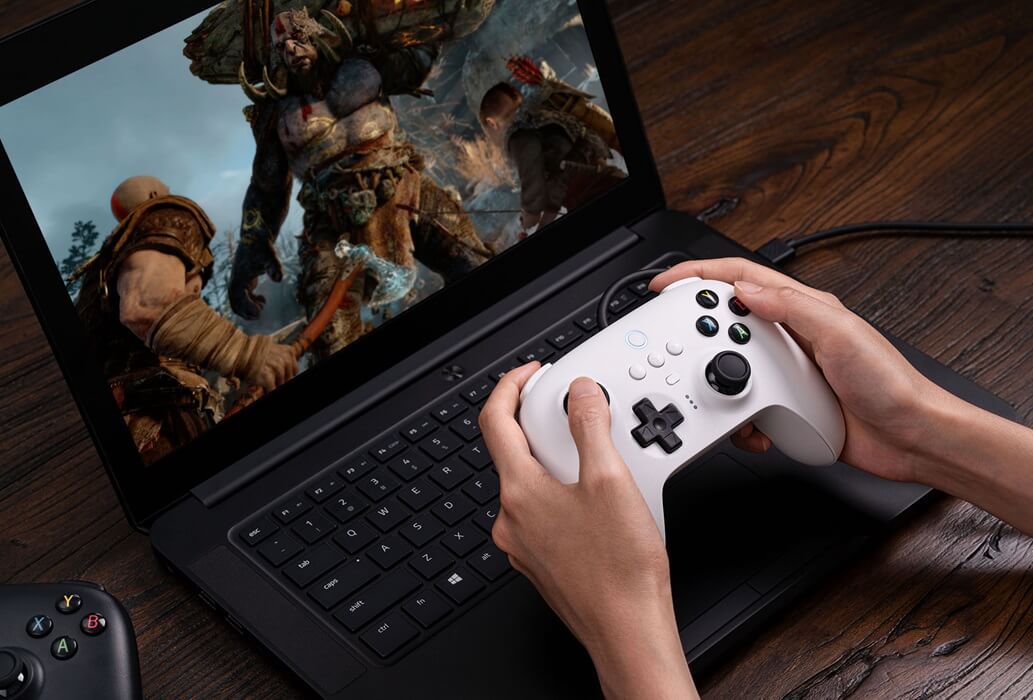
Yes, an 8BitDo controller can absolutely be worth it in 2026. The catch is that “8BitDo controller” is not one product.
It is a whole lineup with very different priorities, and that is where older buying guides usually fall apart.
A Pro 2 is a smart answer if you want a retro-friendly all-rounder for Switch, PC, Apple gear, and Steam. An Ultimate 2 Wireless is a much more aggressive answer for PC-first players who care about latency, dock convenience, and higher-end hardware.
An SN30 Pro is easy to love if you value portability and d-pad-heavy games. It is much easier to overrate if you expect full-size comfort for four-hour shooter sessions.
My practical view is simple: 8BitDo is easiest to recommend when you shop by platform and play style, not by brand alone.
If you just want the short answer, here it is. 8BitDo is strong on value, customization, and multi-device flexibility. It is weaker when you want every first-party feature, the simplest compatibility story, or one controller that behaves exactly the same everywhere.
If gaming hardware buying guides are on your radar right now, our breakdowns of whether the PS5 is being discontinued, whether the Samsung A56 is worth it, ASUS laptop pros and cons, and hands-free gaming with a webcam add useful context around where gaming gear is heading.
Table of Contents
Quick Answer: Is an 8BitDo Controller Worth It?
Yes, if you care more about value, customization, retro-friendly design, and multi-device use than about having every first-party extra.
8BitDo controllers are usually most compelling for people who bounce between devices, care about d-pad quality, or want more control over button mapping and profiles than cheap third-party pads normally offer.
They are less compelling if you want one console-specific controller with zero friction and zero feature compromise. That is where first-party pads still hold an edge.
| Question | Best Short Answer |
|---|---|
| Are 8BitDo controllers good overall? | Yes, but quality and feature fit depend heavily on the exact model. |
| What is the safest all-rounder? | Pro 2 for broad compatibility and flexibility. |
| What is the best PC-first performance pick? | Ultimate 2 Wireless if you want docked convenience and lower-latency ambitions. |
| What is the biggest buying mistake? | Assuming all 8BitDo controllers support the same platforms and features. |
| When should you buy first-party instead? | When full console-native features matter more than customization or cross-platform value. |
Current 8BitDo Lineup at a Glance
The brand only makes sense once you stop treating it like one generic controller brand. In practice, you are choosing between very different families.
That is why I think the smartest way to judge 8BitDo is by buyer type, not by logo loyalty.
| Model Family | Best For | Main Strength | Main Watch-Out |
|---|---|---|---|
| Ultimate 2 Wireless | PC and Steam-first players who want premium feel | TMR sticks, dock, motion support in 2.4G mode, 1000Hz wired and 2.4G polling | Not the cleanest pick for Switch-first shoppers |
| Pro 2 | Switch, PC, Apple, Android, and retro-minded all-rounders | Hall effect sticks, back buttons, profile switching, broad compatibility | Still misses some first-party Switch features |
| SN30 Pro | Retro and indie players who want portability | Compact body, strong d-pad identity, surprisingly broad compatibility | Less comfortable for large hands or long modern-action sessions |
| Ultimate 2C Wireless | Budget-minded PC and Android players | Hall effect sticks and triggers, 1000Hz polling, lower price ceiling | Simpler compatibility story and fewer premium extras |
If you are asking whether 8BitDo is worth it, this table is really the answer. The right model can feel like a steal. The wrong model can feel like you bought a controller with the wrong mission.
What 8BitDo Gets Right
8BitDo wins when it behaves like a company obsessed with how controllers actually feel in the hand, not just how they look on a product card.
That sounds obvious, but a lot of third-party pads still feel like copies of better ideas. 8BitDo at its best feels more intentional than that.
1. The brand understands that compatibility is a feature, not a footnote
This is one of the easiest reasons to recommend 8BitDo. The current Pro 2 and SN30 Pro pages are very explicit about broad support across Switch, Windows, SteamOS, Android, and Apple devices.
That matters because a lot of buyers are no longer living on one platform. They move between a Switch, a handheld PC, a Mac, a phone, and a TV box.
When one controller can cover several of those jobs without feeling cheap, the value story gets much stronger.
2. Customization is better than most people expect
8BitDo’s current Ultimate Software V2 pitch is not subtle. The company frames it as a one-stop solution for supported devices, and that is basically the right way to think about it.
You can remap buttons, adjust stick and trigger sensitivity, control vibration, and save profiles. On the right model, that takes the controller from “good” to “fits me.”
This is especially useful if you split your time between retro games, shooters, racing games, and platformers. A controller that can change with you is worth more than one fixed layout that is merely acceptable everywhere.
“Switch compatibility does not support HD rumble or amiibo scanning.”
8BitDo Pro 2 official product page
That official note is useful because it captures the whole 8BitDo proposition in one move. You often get flexibility and tuning, but you do not always get every console-native extra.
3. The hardware story is stronger in 2026 than old articles suggest
One reason many older 8BitDo reviews now feel stale is that the current lineup is more serious than the nostalgic reputation implies.
The official Ultimate 2 Wireless page now leans on TMR sticks, Hall effect triggers, motion support in 2.4G mode, remappable fast bumpers, and 1000Hz polling in wired and 2.4G use. That is not toy-controller language. That is performance-hardware language.
The Pro 2 and SN30 Pro pages also now emphasize Hall effect sticks, which matters because drift anxiety has become one of the first questions buyers ask about any controller.
4. 8BitDo still understands d-pads and retro-friendly layouts
This is where the brand keeps its identity. If you mostly play fighting games, retro compilations, puzzle games, platformers, emulators, or d-pad-heavy indie titles, 8BitDo still makes more emotional sense than many bulky “universal” pads.
The SN30 Pro in particular keeps that classic shape without becoming useless for modern play. Officially it still offers clickable sticks, rumble, motion control, Bluetooth, and USB-C, which is a lot for something so compact.
Where 8BitDo Falls Short
8BitDo is easy to like. It is also easy to oversimplify. The weaknesses are real, and the wrong buyer can absolutely end up frustrated.
1. The compatibility story is broad, but not simple
This is the biggest trap. Buyers hear “works on many platforms” and assume every model works equally well on every platform.
That is not how this lineup works. Pro 2 and SN30 Pro have one compatibility profile. Ultimate 2 Wireless has another. Ultimate 2C Wireless is even more focused.
The practical consequence is that you should never buy an 8BitDo controller by family name alone. Buy the exact model after checking the exact compatibility list.
2. First-party features still matter, and 8BitDo does not always match them
If your ideal controller is a Switch Pro Controller replacement in every single way, or a DualSense substitute with all the console-native bells and whistles, 8BitDo can disappoint.
The official Pro 2 note on missing HD rumble and amiibo support is the cleanest example. That does not make the controller bad. It does mean some people should stop pretending those tradeoffs are irrelevant.
3. Price can climb into “maybe just buy first-party” territory
8BitDo has real value options, but its better models are not bargain-bin throwaways anymore. Once you start looking at premium docks, newer stick tech, and performance features, the savings compared with first-party gear can narrow.
That is where the buying logic changes. If you only need one controller for one console, paying slightly more for native features can make sense. 8BitDo is strongest when you actually use its flexibility.
“8BitDo is easiest to recommend when you buy for a platform and play style, not when you buy for the logo.”
Blue Headline editorial view
4. Some models are better as second controllers than primary ones
This is especially true of smaller retro-styled options. The SN30 Pro is charming, useful, and technically more capable than many people expect.
It is not automatically the best answer for someone whose life is built around shooters, long open-world sessions, or big hands.
That does not mean it is overrated. It means the right use case matters.
Best 8BitDo Models by Gamer Type
This is where I think the article should stop being abstract and start being useful.
Best for most people: Pro 2
If you want one current 8BitDo controller that makes the most sense for the widest set of buyers, I would start with the Pro 2.
The official page now lists support across Switch 1 and 2, Windows, SteamOS, Android, Apple devices, and Raspberry Pi. The support FAQ still highlights its back buttons, profile switch, and broader software availability.
That combination is hard to beat if you want one controller that can move between modern and retro contexts without feeling like a compromise everywhere.
Best for PC-first players: Ultimate 2 Wireless
If your real home base is Windows, SteamOS, or Android rather than Nintendo-first play, the Ultimate 2 Wireless is the more exciting product.
This is the model for buyers who care about dock convenience, lower-latency ambitions, newer stick technology, and a more explicitly premium feature set.
I would not call it the universal safest pick. I would call it the most interesting pick for the right buyer.
Best for retro and travel play: SN30 Pro
If you want the classic 8BitDo feeling, the SN30 Pro is still the identity pick.
The current official page now says it is compatible with Switch 1 and 2, Windows, SteamOS, Android, Apple devices, and Raspberry Pi. It also still calls it a fully featured retro controller with clickable sticks, regular rumble, motion control, and USB-C.
That makes it better than a nostalgia prop. It also does not magically make it the most comfortable controller for every genre.
Best value pick: Ultimate 2C Wireless
If price matters but you still want current hardware priorities like Hall effect sticks, Hall effect triggers, and 1000Hz polling, the Ultimate 2C Wireless is probably the sweet spot.
This is the model I would look at if you want a practical PC or Android controller without paying extra for the whole premium story.
Ultimate vs Pro 2 vs SN30 Pro
If you are stuck between the big three, this is how I would simplify the decision.
Choose Ultimate 2 Wireless if…
You are PC-first, care about lower latency, want a charging dock, and like the idea of buying into the newest flagship-style hardware 8BitDo is pushing.
You are not buying it because it looks retro. You are buying it because it feels like 8BitDo’s answer to “what if we stopped pretending performance people only buy first-party?”
Choose Pro 2 if…
You want the safest balance of modern comfort, retro identity, broad platform support, and customization. This is the least confusing recommendation for most readers.
It is the controller I would point to first if someone said, “I use multiple devices and I want one good answer.”
Choose SN30 Pro if…
You genuinely value the smaller retro form factor, play plenty of 2D or d-pad games, or want something easy to throw into a bag.
Do not buy it because it is cute. Buy it because the shape fits how you actually play.
Software, Firmware, and Long-Term Support
This is one area where 8BitDo deserves more credit than it usually gets.
The current Ultimate Software V2 page positions the app as a one-stop solution, and in practical terms that is the right pitch. Supported devices get meaningful tuning rather than gimmicky checkboxes.
That matters because controller value is no longer just about the day you open the box. It is also about whether the thing gets better or at least stays compatible.
The support site is useful here too. It shows ongoing firmware activity, and the support changelog includes notes about reconnection fixes for Pro 2 and added support for newer devices over time.
I would still frame this realistically. Firmware support is a plus, not a guarantee that every compatibility annoyance disappears forever. But compared with random third-party controller brands that ship once and vanish, 8BitDo looks more serious.
Who Should Buy 8BitDo
You should seriously consider 8BitDo if any of these sound like you:
- You use more than one gaming platform and want fewer controllers on your desk.
- You care about d-pad quality and retro-friendly layouts.
- You want remapping, profiles, and sensitivity tuning without paying obvious premium-controller money.
- You like the idea of a controller that can handle indie games, emulation, handheld PC use, and casual modern play.
- You want better hardware than the usual cheap third-party pad without jumping straight to the most expensive first-party options.
For that buyer, 8BitDo makes a lot of sense. The company’s whole identity works best when flexibility is part of the value equation.
Who Should Skip It
You should probably skip 8BitDo, or at least be much more selective, if any of these sound like you:
- You want perfect first-party feature parity on one specific console.
- You care more about native extras like HD rumble, amiibo support, or platform-specific trigger effects than about customization.
- You hate researching compatibility charts and want the simplest possible plug-and-play answer.
- You mostly play modern action games for long sessions and know smaller retro shapes bother your hands.
- You are only buying one controller for one system and the first-party option is only slightly more expensive.
This is not a knock on 8BitDo. It is just the practical limit of the pitch. The brand is strongest where versatility matters.
Quick FAQ
Is 8BitDo better than first-party controllers?
Not universally. 8BitDo is often better on flexibility and customization. First-party controllers are often better on native console features and simplicity.
What is the best 8BitDo controller right now?
For most people, Pro 2 is the easiest recommendation. For PC-first players who want something more performance-focused, Ultimate 2 Wireless is more compelling.
Are 8BitDo controllers good for Switch?
Yes, several are. But the official compatibility and feature notes matter. For example, Pro 2 supports Switch but does not support HD rumble or amiibo scanning.
Are 8BitDo controllers good for Steam Deck or SteamOS?
Yes, current official pages for models like Pro 2 and SN30 Pro explicitly call out SteamOS support, which makes them stronger options for handheld-PC buyers than older guides suggest.
Do 8BitDo controllers get firmware updates?
Yes. The 8BitDo support site and updater tools show continued firmware activity, including support additions and fixes for connection issues.
Bottom Line
8BitDo controllers are worth it when you want smart tradeoffs, not imaginary perfection.
The brand’s biggest strength is that it gives you more range than the old “retro third-party pad” stereotype suggests. The current lineup has real substance now, especially if you care about customization, modern stick tech, and using one controller across several devices.
The biggest caution is equally simple. Do not buy by vibe alone.
Buy the Pro 2 if you want the safest all-rounder. Buy the Ultimate 2 Wireless if you are a PC-first buyer who wants the most ambitious current 8BitDo option. Buy the SN30 Pro if you genuinely want the compact retro identity and not just the nostalgia.
If you do that, 8BitDo is easy to recommend. If you ignore the platform differences and feature gaps, it becomes much easier to regret.
Comments
No comments yet. What did you think?
Comments are closed for now.