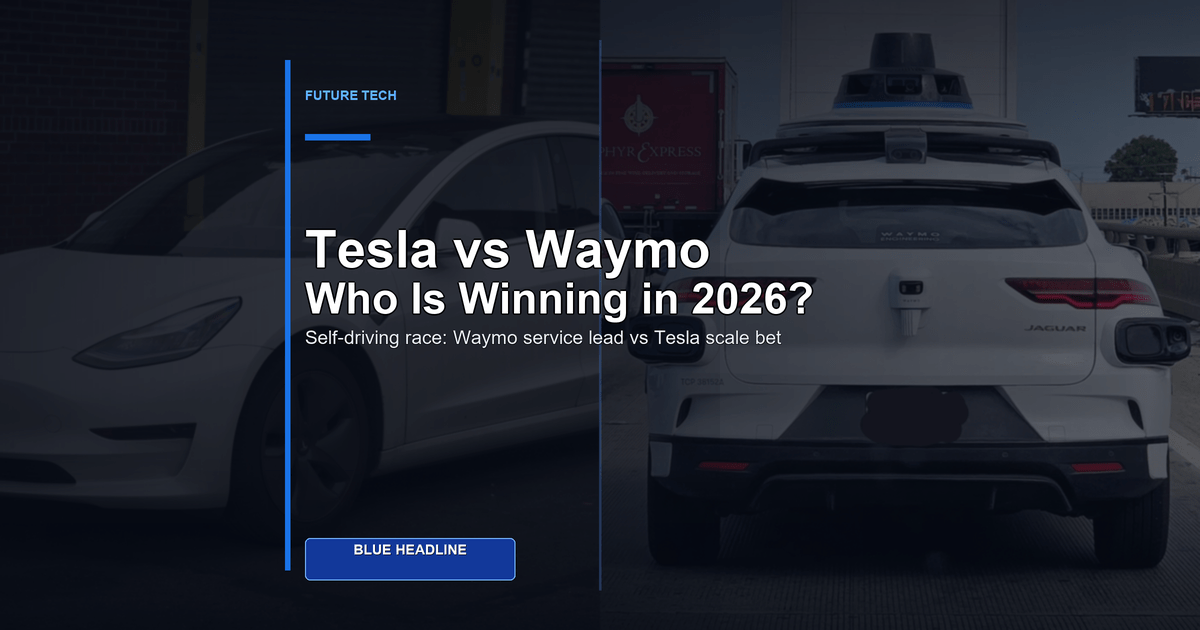
Tesla vs Waymo: Who’s Actually Winning the Self-Driving Car Race in 2026?
Blue Headline ·
Blue Headline explains research plainly. The sources are linked below, with how much to trust them.
If you define “winning” as fully driverless rides with paying passengers today, Waymo is ahead.
If you define “winning” as getting autonomy into millions of consumer vehicles, Tesla has the bigger long-game position.
That is the core tension in 2026: Waymo is proving autonomy as a service, while Tesla is trying to scale autonomy as a platform.
My take after reviewing deployment data, safety disclosures, business models, and operating constraints: Waymo leads the present-tense race, Tesla still has the highest-upside future-tense bet.
Let’s remove the noise first. “Winning” depends on which scoreboard you choose.
Scoreboard
Leader in 2026
Why
Driverless commercial service now
Waymo⭐⭐⭐⭐⭐
Running paid, fully driverless robotaxi operations in active US markets.
Consumer fleet scale + data flywheel
Tesla⭐⭐⭐⭐⭐
Massive installed base and real-world fleet exposure for model iteration.
Near-term autonomy reliability in fixed zones
Waymo⭐⭐⭐⭐
Conservative ODD (operational design domain) plus sensor redundancy.
Potential global deployment upside
Tesla⭐⭐⭐⭐
If unsupervised autonomy clears reliability and regulatory gates, scale could be unmatched.
Practical takeaway: Waymo is ahead in delivered autonomy. Tesla is ahead in theoretical distribution power.
The First Mistake Most Readers Make
Most debates compare Tesla and Waymo as if they are selling the same thing. They are not.
Waymo sells autonomous mobility as a managed service. Tesla sells vehicles today and aims to unlock autonomous monetization later.
That single distinction explains why both sides can be “right” and still talk past each other.
Waymo optimizes for controlled, driverless reliability in mapped geographies.
Tesla optimizes for broad reach, hardware economics, and software improvement at consumer scale.
Waymo’s wins are visible in current robotaxi rides.
Tesla’s wins are visible in fleet footprint and potential network effects.
If you evaluate Tesla with Waymo’s current-city criteria, Tesla looks late. If you evaluate Waymo with Tesla’s mass-market lens, Waymo looks hard to scale economically.
Both views are valid. The wrong move is pretending they are directly interchangeable products in 2026.
Autonomy is not one finish line. It is multiple races running at the same time: safety, scale, economics, and trust.Blue Headline editorial view
Tesla’s Approach: Scale First, Then Perfection
Tesla’s thesis is bold and simple: camera-first end-to-end AI can generalize better than expensive sensor stacks over time.
The company also has an advantage nobody else can fake quickly: a giant customer fleet already on the road.
That gives Tesla two compounding assets:
Distribution: it can ship software capabilities into a huge installed base.
Data velocity: real-world driving scenarios feed iteration cycles at scale.
Where Tesla looks strong in 2026:
Fast improvement cadence in driver-assistance behavior.
Customer willingness to beta-test advanced capability layers.
A future monetization path tied to FSD, subscriptions, and potential network participation.
Where Tesla still carries real risk:
Supervised operation is still not equal to broad unsupervised Level 4 deployment.
Regulators and safety investigators continue to scrutinize incidents and system behavior boundaries.
Public trust can swing quickly after high-profile failures, even if aggregate metrics improve.
My honest read: Tesla is playing the highest-variance strategy in the field. If it works, it scales brutally fast. If it misses reliability thresholds, it delays hard.
For teams tracking broader AI agent behavior and operational risk, this comparison also connects with our AI assistant decision framework.
Waymo’s Approach: Permissioned Precision
Waymo’s approach is the opposite temperament: constrain the domain, overbuild sensing, and deliver driverless reliability where it can be proven.
This is less exciting in marketing terms, but it is very strong in operational credibility.
Waymo’s current edge is not just technology. It is operational discipline:
Mapped and tested service areas with tightly managed ODD boundaries.
Sensor redundancy that improves perception confidence in edge cases.
A service model designed around consistent passenger experience and incident response.
Where Waymo looks strongest today:
Fully driverless paid rides in active US cities.
A stronger present-day proof point for replacing a human driver in real trips.
Higher trust among institutions that prefer conservative risk profiles.
Where Waymo still has constraints:
Hardware and operations cost per deployed vehicle remains high versus consumer-car models.
Geographic expansion is deliberate, which can feel slow next to Tesla-style ambition.
Profitability at very large scale remains the hard business question.
I think Waymo is winning the execution game in 2026. It has fewer dramatic promises, but more delivered autonomy per active service zone.
If you care about what is truly working now, that matters more than flashy timelines.
Safety Scoreboard: What We Can and Cannot Compare
Safety comparisons are where social media takes go wrong fastest.
Tesla and Waymo publish data under different operating conditions, different intervention assumptions, and different deployment contexts.
So the correct question is not “Which chart looks better?” It is “Are we comparing like-for-like behavior in similar domains?”
Safety Lens
Tesla
Waymo
What It Means
Operational mode
Predominantly supervised consumer usage
Commercial driverless rides in approved zones
Intervention assumptions are different by design.
Data scale
Very large fleet exposure
Smaller but tightly controlled service fleet
Scale and reliability are being optimized differently.
Regulatory posture
Frequent high-scrutiny attention in US context
Permitted city-by-city expansion model
Policy friction impacts rollout speed and trust.
Public perception risk
High sensitivity to incident headlines
High sensitivity to service-zone incidents
Both are one major event away from narrative swings.
My recommendation: treat safety as a confidence interval, not a one-line winner label. The cleanest current signal still favors Waymo in fully driverless operation, while Tesla’s strongest signal is broad data capture velocity.
For cybersecurity implications tied to connected fleets and edge systems, this also maps to our AI-enabled risk coverage.
Business Models: Which One Scales Cleaner?
The business model battle is just as important as model accuracy.
Waymo’s robotaxi model controls more of the stack. Tesla’s model externalizes much of the hardware footprint to customer ownership.
That creates opposite strengths:
Waymo strength: service quality and operational consistency can be tightly managed.
Tesla strength: if autonomy unlocks at scale, growth can be faster and more capital-light on a per-mile basis.
Business Question
Tesla Path
Waymo Path
Likely 2026-2028 Pressure
Who funds hardware rollout?
Mostly vehicle buyers + Tesla manufacturing
Waymo/Alphabet-led fleet investment
Capital efficiency versus control quality tradeoff.
Margin structure depends on autonomy reliability and utilization.
Scaling bottleneck
Regulatory approval for unsupervised autonomy
Fleet expansion cost and city-by-city operations
Both face non-trivial scaling constraints.
Customer relationship
Ownership-first
Service-first
Different retention and trust dynamics.
If you are an investor, this is the section to stare at longest. Technical success without economic viability is still failure.
Regulation and Public Trust
Autonomy is a policy product as much as a software product.
A single severe incident can trigger investigations, deployment pauses, or municipal resistance. That is true for both companies.
Right now, Waymo’s conservative deployment style fits how city-level trust is built. Tesla’s style fits how platform-scale disruption is built.
Neither path is automatically better. They are optimized for different political and operational realities.
My experience watching this category: companies that treat regulators as product stakeholders do better over time than companies that treat regulation as a PR obstacle.
The next autonomy leader will not just solve driving. It will solve safety communication, policy coordination, and public confidence at the same time.
Blue Headline mobility forecast
2026-2028 Scenarios: What Happens Next?
The market likely does not end with one winner and one loser. It fragments by use case, city economics, and regulatory appetite.
Scenario
What Must Happen
Who Benefits Most
Probability (Editorial)
Waymo extends urban lead
Steady city expansion + consistent safety performance
Waymo
⭐⭐⭐⭐
Tesla unlocks broad unsupervised reliability
Regulatory-clear unsupervised deployment at high quality
Tesla
⭐⭐⭐
Coexistence by market segment
Urban robotaxi + consumer autonomy grow in parallel
My base case is coexistence with asymmetric strengths: Waymo in premium urban autonomy, Tesla in mass-market autonomy if reliability thresholds are crossed.
The market can support both outcomes without contradiction.
If You Need a Decision Today, Use This Framework
If you are choosing based on reality in 2026, not hype, use this simple filter:
You need proven fully driverless rides now: choose Waymo where available.
You believe in mass consumer autonomy at manufacturing scale: Tesla remains the higher-upside bet.
You are policy or city leadership: prioritize measured operational safety over marketing velocity.
You are a technical observer: monitor intervention trends, incident severity, and regulatory posture quarterly.
This is the same principle we apply in our broader future-tech audits: separate what is already delivered from what is strategically plausible.
For adjacent mobility automation coverage, read our future-tech systems analysis and high-stakes AI tooling benchmark for similar decision framing under uncertainty.
The Data That Actually Decides the Race
When headlines get loud, I use a short list of metrics that are hard to fake and hard to spin.
If you track these consistently, the “who is winning” question becomes much clearer than social-media arguments.
Signal
Why It Matters
What Favors Waymo
What Favors Tesla
Paid fully driverless ride volume
Best proof of autonomous substitution in daily life
High current live service utilization in active zones
Only favors Tesla once unsupervised deployment scales meaningfully
Intervention and incident severity trend
Quality signal beyond raw incident count
Stable downward trend in constrained ODD supports trust
Rapid improvement across broad environments would validate generalization thesis
Regulatory expansion velocity
Determines real market access speed
City-by-city approvals with predictable operating boundaries
Large-jurisdiction acceptance of unsupervised Tesla operations
Unit economics at scale
Decides whether deployment is durable
Higher utilization can offset fleet cost in dense markets
Customer-funded hardware plus software margin can compress cost curve
User trust retention after incidents
Adoption survives only with social legitimacy
Service model can contain trust damage per market
Brand-level trust can recover only with transparent post-incident handling
Notice what is not in this table: viral clips, one-off demos, and CEO timelines. Those are attention signals, not operating signals.
I would rather trust a boring monthly trendline than an exciting keynote promise every time.
Also, keep this in mind: in autonomy, the cost of being wrong is not “we missed growth”. The cost is legal exposure, policy backlash, and years of trust loss.
That is why the winning stack in this market is not just models and sensors. It is models, sensors, operations, policy discipline, and communication quality together.
City Rollout Reality: Why Market Context Changes the Winner
A common mistake is assuming one national winner. In practice, different city profiles reward different autonomy strategies.
Dense downtown corridors, suburban commuter belts, airport-heavy geographies, and weather-heavy regions create very different deployment math.
Market Type
Near-Term Edge
Why
Risk to Watch
Dense urban core with strong transit demand
Waymo
Managed fleet operations and fixed-zone reliability align well
Cost pressure if expansion speed lags demand growth
Suburban sprawl with high private-car ownership
Tesla (long-term)
Consumer vehicle footprint and broad route variety become strategic assets
Unsupervised reliability and policy approval timing
Tourism/airport-heavy city
Waymo (near-term)
High repeat routes and predictable pickup-drop corridors
Service disruption sensitivity during peak events
Harsh-weather mixed-road regions
Open race
Sensor redundancy vs generalization capability remains unresolved
Edge-case safety and perception failure handling
If I were advising a city operations team today, I would not pick a winner by brand. I would pick by route profile, enforcement model, emergency protocol maturity, and local risk tolerance.
If I were advising a mobility startup, I would ask one blunt question first: are you optimizing for driverless certainty or distribution optionality?
You can optimize for both eventually, but almost nobody does both well at the same time in the early scaling phase.
This is where many analysts get lazy. They treat geography as a footnote. In autonomous mobility, geography is strategy.
What Could Break Each Strategy First
Strong strategies still fail. The useful audit is not “what if they win”; it is “what fails first if execution slips”.
Company
Primary Break Risk
Early Warning Signal
Mitigation That Actually Works
Tesla
Gap between supervised performance and safe unsupervised deployment
Regulatory friction persists while rollout promises move faster than approvals
Operational density optimization and selective market sequencing
Waymo
Scaling complexity across heterogeneous cities
Longer deployment cycles per new market
Standardized rollout playbooks and modular city-launch ops
My view is simple: Tesla’s biggest risk is timing to unsupervised trust. Waymo’s biggest risk is economic scaling drag.
Neither is a trivial risk. Both are existential if unmanaged.
The market tends to overprice technical headlines and underprice operational drag. That is why many early autonomy takes age badly.
If you are reading this as an investor or operator, keep your bias in check. Ask what breaks under stress, not what looks impressive in ideal conditions.
The company that wins autonomy at scale will likely be the one that turns incident response and regulatory alignment into core product capabilities, not compliance afterthoughts.
Blue Headline risk thesis
A Practical Quarterly Scoreboard for Readers, Investors, and Operators
If you want to follow this race without getting trapped by hype cycles, use a quarterly checklist.
I use this exact format when updating autonomy coverage internally:
Operational progress: Did driverless ride volume and service reliability improve in production markets?
Safety quality: Did severe-incident frequency trend down, and did disclosure quality improve?
Regulatory traction: Did approvals expand in meaningful markets, or stall under scrutiny?
Economic clarity: Did cost-per-mile and utilization trends move toward durable margins?
Trust resilience: How did riders, cities, and insurers respond after negative events?
Then I score each company by weighted importance, not equal-weight vanity metrics:
Metric Weight
Tesla Priority
Waymo Priority
Interpretation Rule
30% Safety quality trend
Critical
Critical
No company “wins” long-term with unstable safety confidence.
25% Live autonomous service value
Emerging
Core
Waymo leads this category now; Tesla must convert ambition into operation.
20% Regulatory momentum
Critical
Critical
Policy velocity determines real scaling speed for both.
15% Economic viability trajectory
High
High
Margins and utilization decide survivability after excitement fades.
10% Narrative/trust resilience
High
High
Trust drawdowns create long recovery cycles in mobility markets.
This framework is intentionally practical. You can update it every quarter without needing inside access or speculative assumptions.
And yes, this is less fun than posting “X already won” on social media. But it is far more useful for real decisions.
If you only remember one thing from this article, remember this: in autonomy, consistency beats virality.
What This Means for Consumers, Cities, and Investors
Most readers do not need to pick a winner like a sports bracket. They need to make practical decisions over the next 12 to 24 months.
Here is the useful version of this race for the people who must act, budget, and take responsibility.
Stakeholder
Best Current Move
Biggest Mistake to Avoid
Consumers
Use advanced autonomy features as assistance, not immunity
Believing labels remove supervision responsibility in mixed traffic reality
Cities/transport agencies
Approve staged rollout corridors with explicit safety and reporting gates
Binary policy posture: total ban or uncontrolled launch with weak accountability
Investors/operators
Track safety, policy, and unit economics together every quarter
Overweighting narrative momentum while ignoring expansion cost and regulatory friction
If you are a consumer, the short rule is easy: until your jurisdiction and product mode clearly permit unsupervised operation, keep active oversight habits.
If you are a city leader, ask for transparent incident classification, response-time standards, and publicly auditable operating boundaries.
If you are allocating capital, ask what survives a stress year, not what wins a headline month.
Autonomy winners will be decided by repeatable quarter-on-quarter execution, not by one impressive demo loop.
One more practical note from our editorial side: when the market narrative flips, avoid swinging from “Tesla already won” to “Waymo already won” or the reverse.
Both narratives are too absolute for a category this early. The better posture is conditional conviction: be clear about what each company has proven, what each still has to prove, and which trigger events would change your view.
That framing keeps you intellectually honest and decision-ready as new data arrives.
Final Verdict: Who Is Actually Winning?
Waymo is winning the autonomy service race in 2026. It has the clearest live proof that driverless transport can run commercially in real cities.
Tesla is winning the autonomy scale narrative. If it crosses the unsupervised reliability and regulatory bar, it can deploy at a pace no rival can match.
So when readers ask me for one-line clarity, I give this answer:
Present winner: Waymo.
Potential future winner: Tesla.
Most likely medium-term reality: segmented coexistence with different dominance zones.
That is less dramatic than social-media hot takes, but it is the most defensible conclusion from the evidence we have right now.
Protect Your Driving Data on Public Networks
Using EV apps, connected-car dashboards, or shared mobility tools on public Wi-Fi? NordVPN helps secure your traffic and account sessions.
Encrypts data on open and shared networks
Helps reduce tracking and interception risk
Discount offers are often available through our partner link
Comments
No comments yet. What did you think?