Industrial robots got good by being precise, fast, and repetitive.
That formula breaks the moment a robot has to work closely with a human body. A machine helping with bathing, rehab, or caregiving cannot act like a factory arm with nicer branding.
It has to learn contact, uncertainty, and small human motion without turning those moments into safety risks.
That is why this new arXiv paper on generative simulation for physical human-robot interaction matters.
It is less about flashy humanoids and more about a harder question: how do you teach robots to behave gently when real-world training data is scarce, expensive, and risky to collect?
The authors’ answer is smart. Build the human-robot world synthetically first, then learn from it at scale.
If you want the broader context, this sits naturally beside our coverage of what physical AI actually is and why safety and real-world constraints matter more than demos.
Table of Contents
Why Physical Human-Robot Interaction Is So Hard
Robots that move boxes already live in a fairly structured world. Robots that touch or assist humans do not.
People shift unexpectedly. Bodies are soft, not rigid. Comfort matters. Trust matters too.
That makes training data much harder to collect. Real contact-rich interactions are slow to record, expensive to label, and ethically awkward to scale.
This paper tries to break that bottleneck instead of pretending it does not exist. That alone makes it more interesting than another generic “care robots are coming” headline.
“We introduce a zero-shot text2sim2real generative simulation framework that automatically synthesizes diverse pHRI scenarios from high-level natural-language prompts.”
Source: arXiv abstract for “Generative Simulation for Policy Learning in Physical Human-Robot Interaction”
That is the key shift. Instead of waiting for giant real-world datasets to appear, the researchers generate the world they need first.
What the text2sim2real Pipeline Actually Builds
The best part of the paper is how much of the workflow it tries to automate. This is not just a pretty simulation demo.
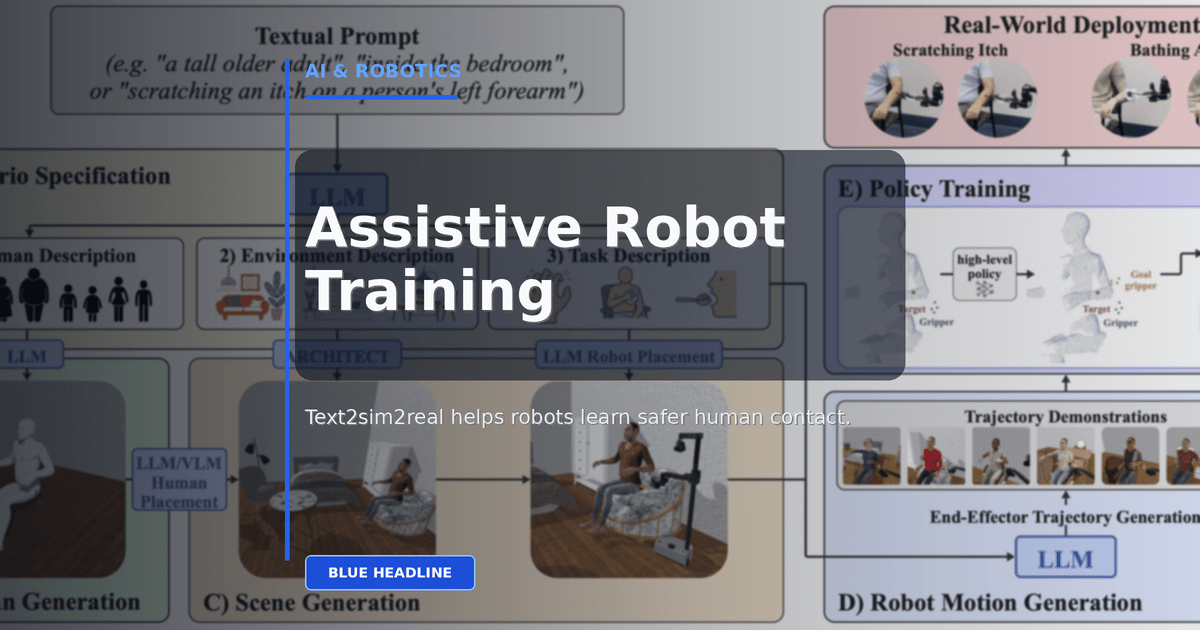
The framework uses language models and vision-language models to generate soft-body human models, scene layouts, and robot motion trajectories for assistive tasks. Then it collects synthetic demonstrations and trains vision-based imitation-learning policies on top of them.
| Pipeline step | What it creates | Why it matters |
|---|---|---|
| Text prompt | High-level task description | Makes scenario generation easier to scale and vary. |
| Scene synthesis | Human models, layouts, and trajectories | Creates richer training worlds without manual setup every time. |
| Synthetic demos | Large batches of interaction data | Reduces dependence on expensive real-world collection. |
| Policy learning | Vision-based control policies | Turns simulation into usable robot behavior. |
In plain English, the researchers are trying to generate training experiences, not just synthetic pictures. That is the difference between an interesting rendering pipeline and something that might actually move robotics forward.
The project website adds useful context too: the Gen-pHRI project page shows how the team frames the pipeline around physically assistive tasks instead of abstract benchmark theater.
Why the Results Matter Even if the Tasks Sound Small
The paper evaluates the approach on two assistive tasks: scratching and bathing. Those may sound modest, but they are exactly the kinds of jobs that expose whether a robot can behave safely around a person.
They require gentle contact. They require adaptation. They also punish brittle behavior fast.
“Our learned policies successfully achieve zero-shot sim-to-real transfer, attaining success rates exceeding 80% and demonstrating resilience to unscripted human motion.”
Source: arXiv abstract for paper 2604.08664
That last phrase is the big one. Real people do not stay frozen in ideal poses just because a lab video would look cleaner that way.
When a paper says the system stayed resilient to unscripted human motion, that is far more valuable than a perfect run in a choreographed setup. It suggests the simulation is teaching something useful about messy, human-centered reality.
What This Could Change for Assistive Robotics
This work matters because collaborative robotics will likely grow first in places where full autonomy is unrealistic but useful assistance is still valuable. Rehab, elder care, and hospital support all fit that pattern.
That is why this paper complements our look at what is real in healthcare AI right now and older reporting on robotics inside medical workflows.
The likely win is not robot caregivers replacing people. The better near-term outcome is safer, better-trained assistance systems that arrive with fewer bad surprises.
- More training can happen before hardware ever touches a person.
- Scenario coverage can expand without scaling risky real-world trials first.
- Teams may be able to test gentleness and adaptation earlier in the development loop.
That is a practical upgrade, not a sci-fi one. In human-facing robotics, practical upgrades are the ones that matter.
What It Still Does Not Solve
This is not the moment to oversell assistive robots. The paper studies two tasks, not the full messy range of care work.
Synthetic generation quality still limits downstream learning quality. Zero-shot transfer in a research setting is also not the same thing as a clinic-ready deployment stack.
But those limits do not erase the real signal. The signal is that collaborative robotics needs better synthetic worlds, better contact-aware data, and safer ways to learn before deployment.
This paper pushes directly into that gap. That is why it deserves attention.
Bottom Line
Generative simulation for physical human-robot interaction matters because it gives robots a better way to practice being careful.
That may sound small, but it is not small at all. Gentle, adaptive behavior is one of the hardest things to scale when real human bodies are part of the task.
My bottom line: if text2sim2real systems keep improving, the biggest near-term win will not be robot caregivers replacing people.
It will be assistive machines that arrive better trained, safer around motion, and more trustworthy in the moments where physical interaction actually matters.
Primary sources and references: arXiv abstract and project website.
Comments
No comments yet. What did you think?