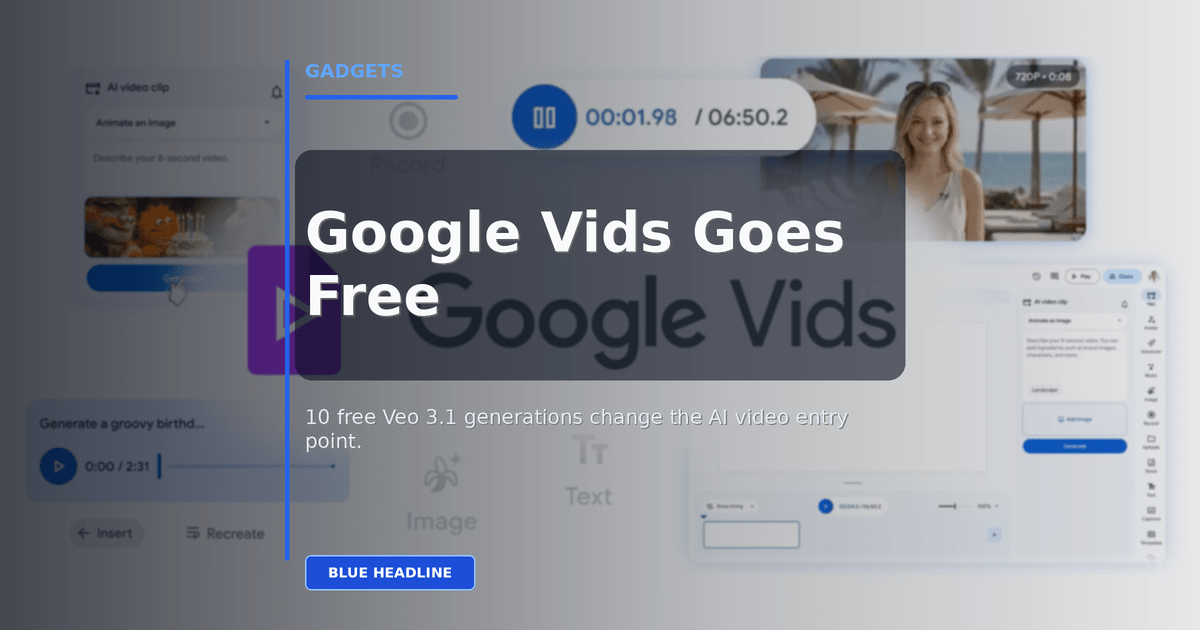
AI video is finally leaving the “cool demo, expensive habit” phase.
Google’s latest Google Vids update matters because it moves video generation closer to normal software behavior.
Instead of treating AI video like a premium side product, Google is pushing it into a familiar workflow that already handles creation, editing, and publishing.
That changes the market in a very specific way. When the entry point is a normal Google account, the first question stops being “is this model impressive?” and becomes “why would I pay before I try it?”
That is why this launch matters more than another benchmark war. It hits pricing, convenience, and distribution at the same time.
If you want the broader creator-tool context, this sits naturally beside our looks at copyright risk for AI-generated content and which mainstream AI tools are actually worth using.
It also fits the broader Google competition story in our ChatGPT vs Gemini vs Claude vs Copilot comparison.
Table of Contents
What Google Is Actually Making Free
The headline is simple. Anyone with a Google account can now generate Veo 3.1 video clips inside Google Vids at no cost.
“All personal accounts now get 10 video generations every month at no cost.”
Source: Google Vids update, April 2, 2026
That alone would be enough to get attention. But Google is not only tossing out a small free perk and calling it a day.
The company is also positioning Vids as a fuller creation stack, with custom music powered by Lyria 3 and Lyria 3 Pro, directable AI avatars, a browser recorder, and direct YouTube publishing inside the same product.
| Access tier | What you get | Why it matters |
|---|---|---|
| Personal Google account | 10 Veo 3.1 video generations per month at no cost | Lowers the trial barrier for casual creators and small teams. |
| Google AI Pro / Ultra | Custom music, AI avatars, and deeper creative controls | Makes Vids more than a one-click clip generator. |
| Google AI Ultra / Workspace AI Ultra | Up to 1,000 Veo videos per month | Signals that Google wants room for heavier creator and business use too. |
That is a much more strategic rollout than “here is a free demo.” It creates a ladder from casual experimentation to heavier usage without asking new users to start in a dedicated video tool.
Why the Workflow Bundle Matters More Than the Model Name
Most AI video launches focus on the model. Google is quietly focusing on the workflow around the model.
That is the smarter move. Users do not just need clips. They need music, avatars, rough assembly, capture tools, and an easy way to publish without exporting through five different apps.
Google’s update covers more of that loop than the average “look at this gorgeous generated shot” announcement.
The new browser recorder and direct YouTube publishing are not flashy frontier-model features, but they are exactly the kind of features that turn occasional curiosity into repeat use.
That is also why this story feels more commercially meaningful than a pure model demo like Meta’s Movie Gen showcase. Demos win attention. Workflow wins habits.
Why This Puts Pressure on Paid-First Rivals
Google does not have to prove it built the single best AI video model on earth to cause pricing pain. It only has to make “good enough, already here, already bundled” feel easier than paying for a specialist tool first.
That is the real pressure point. Plenty of creators will still want higher-end control, better cinematic output, or deeper editing environments elsewhere.
But the casual and mid-market segment now has a much easier excuse to start inside Google’s ecosystem.
That segment matters. It includes teachers, students, side hustlers, social managers, internal comms teams, event organizers, and small businesses that need usable video more often than they need elite cinematic output.
Google understands that behavior shift well. This is the same playbook that helped many Google products spread before: make the default path cheap enough and convenient enough that inertia does most of the marketing.
The Catch: Free Is Still Not the Same as Production Scale
There is still a ceiling here, and it matters.
Ten free generations per month is enough to change perception. It is not enough to replace a serious, high-volume production workflow.
Heavy creators will still care about generation quality, editing depth, style control, turnaround speed, and how easily they can reuse assets across projects.
Google Vids is getting more capable, but it is still designed like a mainstream Google workflow product, not a niche filmmaker command center.
“Google AI Ultra and Workspace AI Ultra accounts can now generate up to 1,000 Veo videos per month.”
Source: Google help/update materials linked from the Vids launch post
That number is revealing. Google clearly knows some users will want volume, not just novelty. It also shows the company is building a ladder, not a one-size-fits-all offer.
The free tier is the hook. The broader usage tiers are the real monetization map.
What Creators and Small Teams Should Take From This
The practical takeaway is not “cancel every other AI video tool tomorrow.” The better takeaway is that AI video is becoming normal enough to bundle into mainstream software suites.
- Casual creators should expect free or low-friction trial paths to become the norm.
- Small teams should evaluate the whole workflow, not just clip quality.
- Serious creators should start thinking about portability, ownership, and copyright rules before the stack gets stickier.
That last point matters more as AI-generated media spreads.
If you are building commercial content pipelines, it is worth pairing this story with our guide to copyright questions creators need to handle in 2026.
Google may not win every creator on raw quality alone.
But if ordinary users start expecting free generations, built-in editing flow, and direct publishing by default, the whole field has to justify why extra friction is still worth paying for.
Bottom Line
Google Vids matters because it pushes AI video toward ordinary software behavior.
That is bigger than it sounds. Once a mainstream account ecosystem makes video generation feel bundled, cheap, and easy to try, the rest of the market loses some of its pricing power before the user has even compared outputs.
My bottom line: Google is not just shipping more AI video features. It is trying to make AI video feel boringly normal.
If that works, the competitive pressure on paid-first rivals will arrive faster than a lot of flashier model demos ever could.
Primary sources and references: Google Vids update, Lyria models in Vids, and Google help page for higher Veo generation limits.
Comments
No comments yet. What did you think?