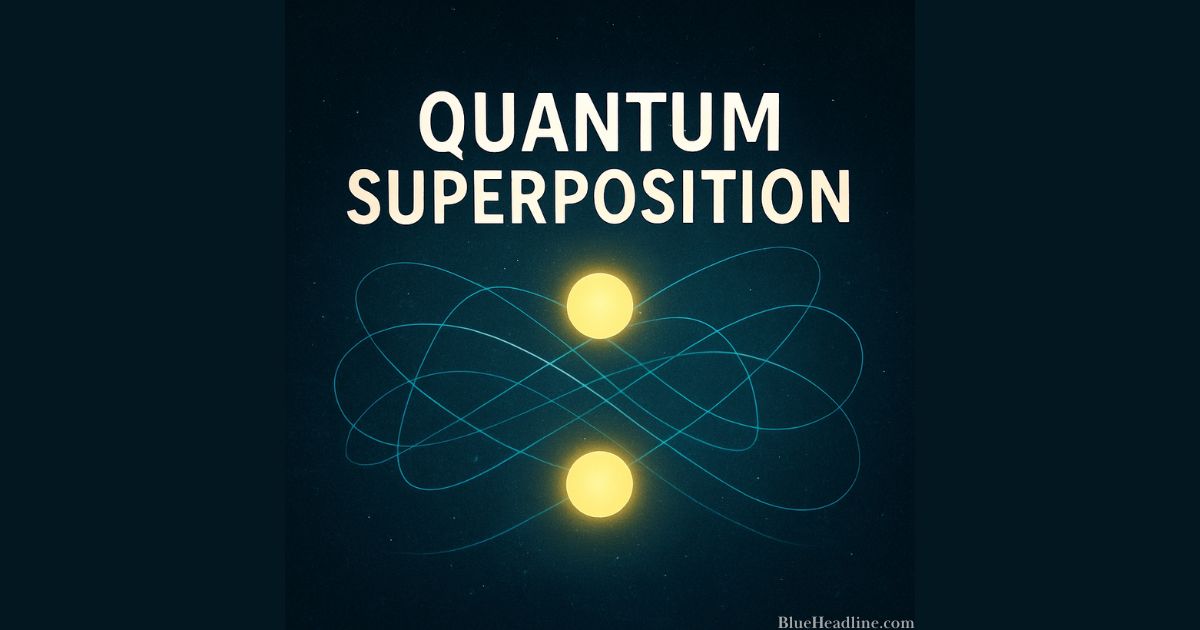
Quantum superposition is real, but the phrase “matter in two places at once” needs translation.
It is a useful shortcut for readers. It is also the point where many explainers start lying by omission.
In quantum mechanics, a particle can be described as a combination of multiple possible states before measurement. That does not mean a coffee mug is casually duplicated across your kitchen.
It means the math of the system includes more than one allowed outcome, with measurable interference effects that classical probability cannot reproduce.
This is why superposition matters. It is one of the core ideas behind quantum experiments, quantum computing, and quantum teleportation, but it only makes sense if you keep the limits of the analogy in view.
Table of Contents
- Quick Answer
- What Quantum Superposition Actually Is
- A Better Mental Model
- Why “Two Places at Once” Is Both Useful and Misleading
- What Superposition Is Not
- What Measurement Changes
- How We Know Superposition Is Real
- Why Everyday Objects Do Not Look Quantum
- How Labs Create and Protect Superposition
- Why Superposition Matters for Quantum Computing
- What Superposition Has To Do With Teleportation
- Recent Experiments That Pushed the Limits
- FAQ
- Bottom Line
Quick Answer
Quantum superposition means a quantum system can be described as a combination of multiple possible states until measurement picks a definite outcome.
If someone says matter is “in two places at once,” the safer version is this: the system behaves as though more than one location or state contributes to the result.
That difference matters because superposition is not ordinary ignorance. It produces interference patterns and other effects that a classical hidden answer does not.
| Question | Short Answer | What To Watch Out For |
|---|---|---|
| Is it real? | Yes. Interference experiments and modern quantum devices rely on it. | Do not confuse it with a coin flip or missing information. |
| Is it literally two copies? | Not in the everyday sense. | The phrase is shorthand, not a license for sci-fi wording. |
| Does measurement matter? | Yes. Measurement gives a definite outcome. | “Collapse” is a common description, but the interpretation is deeper than one word. |
| Why do big objects not look quantum? | Because interaction with the environment destroys fragile coherence. | Decoherence is the practical reason, not because quantum rules stop existing. |
| Why does industry care? | Superposition is one ingredient in quantum sensors, quantum networks, and quantum computing. | Superposition alone does not magically create speedup. Interference and entanglement matter too. |
What Quantum Superposition Actually Is
The clean version is this: a quantum state can be written as a weighted combination of other allowed states.
For a qubit, that often means a state built from |0> and |1> at the same time, with amplitudes that determine measurement probabilities.
IBM’s learning material on superposition is useful here because it makes the key distinction clearly. A superposition is not just a classical 50/50 state that we have not looked at yet.
Classical uncertainty says the system already has one true answer and we are ignorant. Quantum superposition says the state itself is different before measurement.
That difference shows up when amplitudes interfere.
Two classical probabilities can add. Quantum amplitudes can add or cancel, which is why quantum systems produce patterns that ordinary randomness cannot fake.
Superposition is best understood as a physical state with multiple allowed components, not as a hidden classical answer waiting in the dark.
Plain-English summary of the IBM Quantum learning module
If you want the wider context, our guide to facts about quantum mechanics covers the broader rules that make superposition feel strange in the first place.
Superposition is one pillar. Wave behavior, measurement, and entanglement complete the picture.
A Better Mental Model
If the phrase “two places at once” keeps tripping you up, use a better picture.
Think of superposition less like two solid objects and more like a state that contains multiple possible components with different weights and phases.
The weights matter because they shape measurement probabilities. The phases matter because they determine whether components reinforce or cancel one another.
That second part is the one readers usually miss.
Classical possibilities do not cancel each other the way quantum amplitudes can. That is why a good mental model needs more than the phrase “many options.”
You can also think of a superposition as a kind of recipe. The final measurement gives one outcome, but the recipe that produced that outcome included several ingredients.
Change the recipe, and the statistics of repeated measurements change too.
This is not perfect language, but it is safer than imagining tiny objects flickering like broken pixels.
It also explains why physicists care so much about basis choice. A state can look definite in one measurement basis and like a superposition in another.
That sounds abstract until you realize it is exactly how qubits are manipulated in actual devices.
The value of a mental model is not that it matches the equations perfectly. It is that it keeps you from making the same wrong inference every time the topic appears in a headline.
Why “Two Places at Once” Is Both Useful and Misleading
The phrase survives because it works as a first hook. Readers immediately understand that quantum behavior is not classical behavior.
The problem starts when the shortcut becomes the whole explanation.
If an electron is in a superposition of positions, physicists do not mean it is a tiny marble duplicated like a file copied to two folders.
They mean the state includes more than one position component, and experiments can reveal interference between those possibilities.
This is why the better sentence is usually, “the particle is in a superposition of positions,” not “the particle is literally sitting in two ordinary places the way a chair would.”
That may sound fussy, but it protects the reader from a bad mental model.
Schrodinger’s cat exists for the same reason. It was designed to make the weirdness impossible to ignore, not to suggest that normal household objects behave like lab-isolated qubits under everyday conditions.
The cat story is still useful if you treat it as a warning label against naive realism, not as a literal household physics demo.
What Superposition Is Not
This topic gets cleaner when you say what it does not mean.
It does not mean the laws of logic are suspended. A measured electron is not reported as “left and right” in the same detector readout.
It does not mean scientists are simply unsure which answer was already there. That is classical hidden-information thinking, and it misses the interference part that makes quantum theory quantum.
It also does not mean every science-fiction sentence that includes the word “quantum” gets a free pass.
If someone jumps from superposition to consciousness manifesting reality, cloning matter, or faster-than-light messaging, the burden of proof just became very high.
The discipline here is useful. Quantum mechanics is genuinely strange, but it is not a blank check for vague mysticism or marketing copy.
Good explanations keep the weirdness and remove the nonsense.
That is especially important on high-traffic articles, because shorthand that feels harmless in a headline often becomes misinformation once readers repeat it elsewhere.
What Measurement Changes
Measurement is the part that most pop explainers flatten into one sentence.
They say “when you look, the wavefunction collapses,” then move on as if nothing else needs unpacking.
At the practical level, measurement gives a definite result. If a qubit is measured in the computational basis, you do not read “both.” You read 0 or 1.
What came before that result is the quantum part. The pre-measurement state can still contain multiple components, and their amplitudes control the odds.
That is why superposition is not just philosophical decoration. It predicts actual measurement statistics.
The interpretation of what collapse means is still debated across different frameworks, but the operational result is not. Quantum experiments repeatedly show the same measurement structure.
That is enough for engineers to build systems around it, even when philosophers remain busy.
How We Know Superposition Is Real
The classic evidence starts with interference experiments.
In the double-slit setup, particles such as electrons produce an interference pattern when both paths remain available. That pattern is the signature that the possibilities combine like waves.
If this were only ordinary ignorance, you would not get the same interference structure.
The evidence does not stop with textbook diagrams. Researchers have also demonstrated quantum interference with large molecules, which matters because it pushes the effect beyond the easiest toy examples.
A Nature Physics paper on molecular superposition beyond 25 kDa is one of the cleaner examples of that scaling story.
That does not mean everyday macroscopic objects are casually floating around in visible superpositions. It means the boundary is a practical one shaped by coherence, not a magical line where quantum theory retires.
The strongest evidence for superposition is not a slogan. It is the repeated appearance of interference effects in systems that classical probability cannot model on its own.
Why the double-slit experiment still matters
If you want a less abstract route into the topic, our article on quantum computing explained simply shows how this same behavior is turned into something engineers can actually program against.
Why Everyday Objects Do Not Look Quantum
This is where decoherence enters and saves your intuition from total collapse.
Quantum systems keep phase relationships between components of a superposition. Those relationships are what make interference possible.
When the system interacts with air, heat, light, vibration, electronics, or other environmental noise, that coherence leaks away.
Once coherence is lost, the quantum behavior you were hoping to observe stops looking clean and starts looking classical.
That is why quantum labs are full of vacuum systems, shielding, cryogenic setups, and brutal engineering discipline.
The issue is not that large objects are exempt from quantum rules. The issue is that they are impossible to isolate perfectly.
A dust particle, a warm object, or a laptop on your desk is continuously coupling to the environment. In practice, the world is constantly “asking” it about its state.
This is also why Schrodinger’s-cat examples are pedagogically useful but physically dangerous if read too literally. A living cat is an open system in the loudest possible way.
Decoherence is the bridge between quantum law and classical appearance.
How Labs Create and Protect Superposition
One reason superposition gets misunderstood is that readers see the theory but not the engineering.
Quantum states do not sit around politely waiting for us. Researchers have to prepare them, manipulate them, and measure them before noise tears the coherence apart.
How that happens depends on the platform.
In superconducting systems, labs use microwave pulses and extremely low temperatures. In trapped-ion systems, they use lasers, electromagnetic fields, and careful timing.
In photonic systems, they control paths, phase, and detection with brutal precision.
The common problem is always the same. You need enough isolation to preserve coherence, but enough control to do something useful before the state falls apart.
This is why the hardware story matters so much. Superposition is not only a theorem on a whiteboard. It is a condition that has to be physically maintained.
Error correction enters the picture for the same reason. Real qubits are noisy, so useful machines need layers of protection that can detect and correct failures without destroying the computation.
That challenge is why the jump from elegant quantum principles to working quantum products is slow, expensive, and technically serious.
If the field looked easy from headlines alone, that is because the headlines skipped the refrigeration bill.
There is also a timing issue. A platform can generate a beautiful superposition for a moment and still be a weak computer if gates are sloppy or readout is noisy.
That is why quantum progress is usually measured across several metrics at once.
- How long coherence survives
- How accurately gates can be applied
- How cleanly measurement works
- How much control survives as systems scale up
That list sounds less cinematic than “two places at once,” but it is closer to how the field actually moves.
Modern quantum engineering is the business of protecting fragile superpositions long enough to turn them into useful outcomes.
Why Superposition Matters for Quantum Computing
Superposition is part of the reason quantum computing is interesting, but it is not the whole reason.
A qubit can occupy a superposition of |0> and |1>. With more qubits, the state space grows quickly, which is why people talk about exponential scaling.
That said, the sloppy claim that quantum computers “try every answer at once” is not good enough. If that were the whole story, every quantum algorithm would be trivial.
The real advantage comes from preparing states carefully, letting amplitudes interfere, and boosting useful outcomes while suppressing useless ones.
That is a very different claim from raw parallelism.
IBM’s superposition material is useful here again because it shows how a simple Hadamard operation creates a qubit state that measures 0 or 1 with equal probability, but still carries structure beyond a coin toss.
Once you combine superposition with interference and entanglement, you get the foundations for algorithms that classical machines struggle to match.
That is why this topic matters beyond physics classrooms. It feeds directly into the business and infrastructure questions behind post-quantum cryptography and the longer-term security issues covered in our piece on quantum-resistant algorithms.
Superposition is not just weird. It is strategically relevant.
What Superposition Has To Do With Teleportation
Quantum teleportation sounds like the point where explainers lose adult supervision.
The clean version is simpler. Quantum teleportation transfers the state of a system from one location to another by using entanglement, local operations, and classical communication.
It does not beam a human body across a room. It does not send usable information faster than light.
That last correction matters because older internet summaries often get it wrong.
Superposition matters here because what is being transferred is a quantum state, not a classical bit pattern alone.
A 2024 Optica paper on teleportation over deployed fiber showed why this area is moving from pure theory toward infrastructure.
That is a better way to talk about progress than promising Star Trek by next quarter.
If you want the broader public-facing version, our older piece on teleportation technology covers the consumer imagination around the topic. This article is the stricter physics layer underneath it.
Recent Experiments That Pushed the Limits
This part of the story does keep moving, which is why old quantum posts age badly if nobody refreshes them.
One of the better recent science-news summaries from Nature in 2026 covered a new “largest ever” Schrodinger-cat style superposition result.
Stories like that matter because they show the field is not arguing only about textbook electrons. Researchers are actively testing how far coherent quantum behavior can be extended.
The scaling work is hard because every increase in size or complexity increases the ways a system can leak information to the environment.
That is why advances in isolation, error correction, materials, and control systems matter as much as the headline physics claim.
The deeper question is not just, “Can we make a bigger superposition?” It is, “Can we keep it coherent long enough to do something useful or conceptually decisive with it?”
That is the engineering edge of the field.
Why these experiments matter beyond bragging rights
Large-superposition experiments do three useful things.
- They stress-test where decoherence takes over.
- They sharpen measurement and control techniques that later help quantum hardware.
- They make the foundations debate less abstract by forcing the theory to survive harder experiments.
In other words, these studies are not only about making physics headlines weirder. They help define what future quantum devices can realistically do.
That is one reason this subject connects surprisingly well to cybersecurity and infrastructure, not just to philosophy seminars.
If you care about the long tail of quantum computing but still use public Wi-Fi at airports, hotels, or conferences, solve the basic threat model too. Check NordVPN’s current plans if you want a simple layer of encrypted protection while the post-quantum transition is still catching up.
FAQ
Is quantum superposition the same as a 50/50 probability?
No. A classical 50/50 model can match the final odds in some cases, but it cannot reproduce the full interference behavior of a coherent quantum state.
Does superposition mean reality is created only when humans look?
No. Measurement in quantum mechanics is not the same as human eyeballs doing magic. Interaction with measuring devices and environments is enough to matter.
Can a human be put in a superposition?
Quantum theory does not carve out an exception for humans, but in practice a human body is an open, noisy system. Keeping it coherent the way a lab qubit is coherent is not remotely a near-term engineering problem.
Does superposition alone explain quantum advantage?
No. Superposition is necessary to the story, but useful quantum advantage depends on interference, entanglement, control quality, and error handling too.
Is superposition the same thing as entanglement?
No. A single system can be in superposition without being entangled with anything else. Entanglement describes correlations between multiple systems that cannot be factored into separate independent states.
Can superposition happen outside a lab?
Yes, because quantum mechanics is not confined to laboratory walls. What labs provide is enough isolation and control to preserve coherence long enough for the effect to be measured cleanly.
Bottom Line
Quantum superposition is real, experimentally grounded, and central to modern quantum technology.
The phrase “matter in two places at once” is fine as a headline if you immediately translate it into something more precise.
The precise version is this: a quantum state can contain multiple allowed components whose amplitudes affect what measurements can reveal.
That is why superposition powers interference experiments, makes qubits different from classical bits, and shows up in teleportation and quantum-network research.
It is weird, but it is not meaningless weirdness. It is a measurable structure with consequences.
Secure the Boring Part While Quantum Tech Gets the Headlines
Quantum computing is a future infrastructure story. Public Wi-Fi risks are a current one. If you travel, work remotely, or log in from shared networks, a VPN is still one of the easier fixes you can deploy today.
- Encrypts traffic on public networks
- Helps reduce account and session hijack risk
- Useful while the post-quantum security transition is still in progress
Disclosure: This post includes affiliate links. We may earn a commission at no extra cost to you. Pricing and availability can vary by date and region.
Comments
No comments yet. What did you think?