Robotics keeps getting sold like a hardware talent show.
A humanoid walks onstage. A robot arm stacks a few boxes. Everyone is supposed to clap for the future.
NVIDIA’s latest National Robotics Week roundup points somewhere more useful. The real story is not one robot. It is the stack underneath the robot.
That is why NVIDIA’s physical AI push matters for Blue Headline readers. The company is trying to make robot development feel more like a platform business.
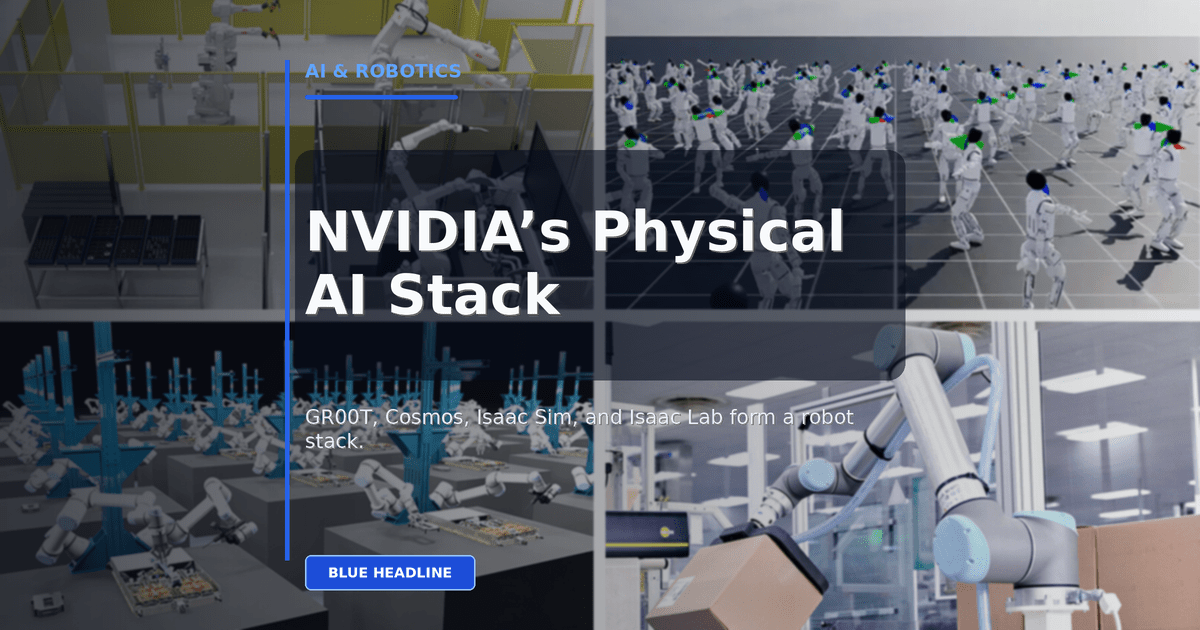
GR00T, Cosmos, Isaac Sim, Isaac Lab, and Newton are being framed as connected layers, not isolated launches.
If you want the bigger category context first, pair this with our explainers on what physical AI actually means and why latency, safety, and liability now matter more than demos.
Table of Contents
Why NVIDIA Is Pitching a Platform, Not a Single Robot
NVIDIA’s best move here is also its least flashy one. It is not pretending one robot body will win the whole market.
Instead, it is arguing that robotics gets easier when teams can train, simulate, validate, and deploy from one connected workflow. That is a much stronger story than another “look, the robot waved back” headline.
“At the core is a full-stack, cloud-to-robot workflow that connects simulation, robot learning and edge computing — making it faster to build, train and deploy intelligent machines.”
Source: NVIDIA Blog, “National Robotics Week — Latest Physical AI Research, Breakthroughs and Resources”
My take is simple: that sentence matters more than any individual robot demo in the post. It tells you where NVIDIA thinks the money, leverage, and long-term control will sit.
This also fits what Blue Headline already saw in robotics manufacturing coverage. The hardest problem is rarely “can a robot move?” The harder problem is whether it still works when the environment gets messy, expensive, and unpredictable.
The Stack Is One Sim-to-Real Loop
It is tempting to read GR00T, Cosmos, Isaac Sim, Isaac Lab, and Newton as separate product bullets. That misses the point.
They are more useful as one loop. GR00T handles robot reasoning and action. Cosmos helps generate and model the worlds robots need to learn from.
Isaac Sim and Isaac Lab provide the testing ground. Newton makes the physics more believable when contact, force, and manipulation start to matter.
That loop is what makes sim-to-real transfer feel less like wishful thinking. A robot can practice in synthetic environments, fail cheaply, learn faster, and reach the real world with fewer ugly surprises.
- GR00T gives robots a vision-language-action layer for multistep behavior.
- Cosmos helps create richer synthetic worlds and training data.
- Isaac Sim and Isaac Lab let teams stress-test behavior before hardware mistakes get expensive.
- Newton improves contact-rich physics, which matters for dexterous work, not just simple motion.
That is why the AWS comparison works. AWS did not win cloud by shipping one killer app. It won by becoming the default place where many teams could build.
What Each Layer Actually Does
The easiest way to read NVIDIA’s strategy is as a stack map. Each layer solves a different bottleneck, but the value shows up when the layers reinforce each other.
| Layer | What it does | Why it matters |
|---|---|---|
| Isaac GR00T | Handles vision-language-action reasoning for robotic tasks. | Helps robots follow more flexible, multistep instructions. |
| Cosmos | Builds synthetic data and world models for training. | Lets teams scale learning faster than real-world data collection alone. |
| Isaac Sim | Provides realistic simulation environments. | Reduces the cost of failure before deployment. |
| Isaac Lab | Supports policy training, benchmarking, and iteration. | Makes robot learning feel more repeatable and less handcrafted. |
| Newton | Adds contact-rich physics and better manipulation modeling. | Improves how robots learn tasks that involve real object interaction. |
This is the real shift. Robotics is moving away from isolated demo engineering and toward reusable infrastructure.
If NVIDIA gets this right, it becomes valuable even when another company builds the best robot body. Platform layers often win that way.
The Hospital Example Is the Real Test
The strongest part of the source article is not the warehouse language. It is the surgical example.
NVIDIA highlights PeritasAI, which is using NVIDIA’s healthcare robotics stack and the Rheo hospital automation blueprint to build multi-agent intelligence for operating-room environments.
That is where physical AI stops sounding abstract.
“Using NVIDIA Isaac for Healthcare and the Rheo blueprint for hospital automation, the company is developing multi-agent intelligence that can sense, coordinate and act in real time.”
Source: NVIDIA Blog, surgical robotics section
That line matters because hospitals are brutal test environments. Precision matters. Timing matters.
Sterile coordination matters too. You cannot hide weak simulation behind a polished demo reel there.
This angle also connects neatly to our broader reporting on what is actually real in healthcare AI and older coverage of robotics inside medical workflows.
The near-term win is not a robot replacing surgeons. The believable win is better awareness, cleaner coordination, and smarter instrument handling around human teams.
That is a much more serious story. It is also a much more investable one.
Natural-Language Control Is Getting Practical
NVIDIA’s NemoClaw section is another clue that the stack is maturing. The headline is not “robots can hear you now.” The deeper point is that natural-language control is being tested inside simulation before it ever touches real hardware.
In the source example, a Nova Carter robot can follow plain-language prompts inside Isaac Sim, with instructions translated into executable Python over a custom REST API. That lowers iteration cost in a big way.
Developers can talk to the robot, inspect the behavior, adjust the environment, and repeat the loop quickly. That is far more useful than hard-coding every action path by hand.
It also makes robotics look a little more like software development. The physical world is still harder, of course. But the workflow is starting to feel less bespoke and more toolable.
Why This Matters Beyond Humanoids
The smartest thing NVIDIA does in this post is spread the evidence across different robot categories. It is not only about humanoids.
The same article points to underwater simulation through OceanSim, generalist benchmarking through RoboLab, and smarter palletizing in warehouse settings. That range is the whole argument.
If one stack can help hospitals, warehouses, underwater systems, and factory robots, NVIDIA does not need to win one narrow robot niche. It can win the development layer that many niches depend on.
“Physical AI has arrived — every industrial company will become a robotics company.”
Jensen Huang, founder and CEO of NVIDIA, in NVIDIA’s March 2026 robotics press release
That quote from the official NVIDIA Newsroom announcement is bold, but the surrounding strategy makes it more credible than usual keynote swagger.
The company is not just describing smarter robots. It is building the software, simulation, and data plumbing that makes smarter robots easier to ship.
That is where platform power usually begins.
Bottom Line
NVIDIA’s physical AI push matters because it turns robotics into an infrastructure contest, not just a hardware contest.
GR00T, Cosmos, Isaac Sim, Isaac Lab, and Newton are not exciting because each one sounds futuristic on its own.
They matter because together they create a tighter sim-to-real loop for teams building robots that have to survive messy environments.
My bottom line: the next robotics winners will not just have better bodies. They will have better training worlds and better validation loops.
They will also need better deployment tooling. Right now, NVIDIA looks determined to own as much of that layer as it can.
Primary sources and references: NVIDIA National Robotics Week post, NVIDIA physical AI press release, NVIDIA Isaac GR00T, and NVIDIA Isaac Lab.
Comments
No comments yet. What did you think?